

|
Getting your Trinity Audio player ready...
|
Introduction: A Surprising Discovery on the Moon
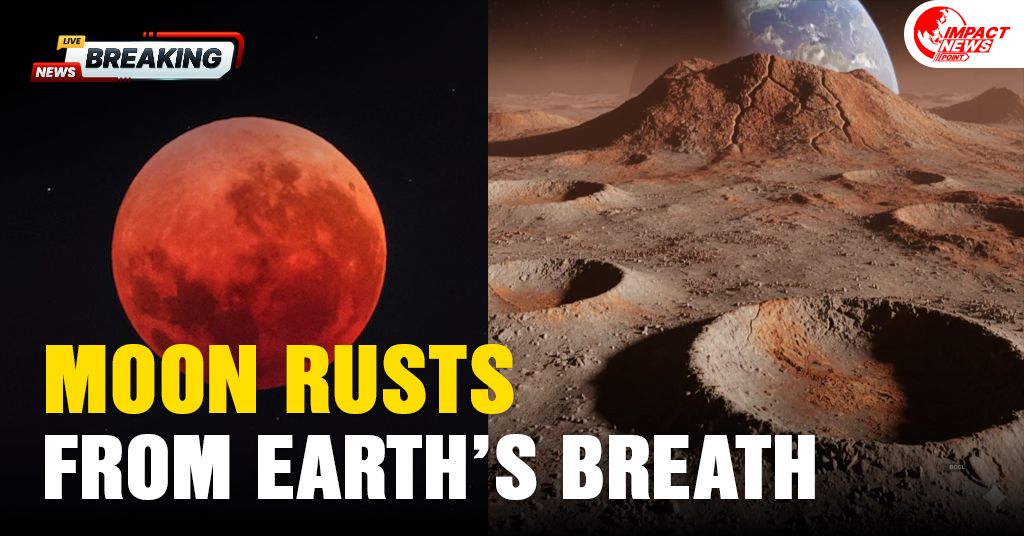
The Moon, long believed to be a dry and unchanged rock drifting in space, is now showing signs of rust. Scientists have uncovered that particles from Earth are traveling through space and causing chemical changes on the Moon’s surface. This discovery reveals a surprising connection between Earth and its natural satellite, challenging previous assumptions about the Moon’s geology.
How Rust Forms on the Moon
Rust, or haematite, usually forms when iron meets oxygen in the presence of water. Earth’s environment is ideal for this process, but the Moon’s surface is extremely dry and lacks oxygen, making the presence of rust perplexing. Initial lunar missions, including India’s Chandrayaan-1 in 2020, identified haematite deposits near the lunar poles, sparking questions about the source of oxygen needed for rust.
Earth’s Role: The “Earth Wind” Effect
Scientists have now explained this mystery with the concept of “Earth wind.” During about five days each month, Earth aligns between the Sun and the Moon, shielding the Moon from solar particles. During this time, the Moon is exposed mainly to particles escaping from Earth’s upper atmosphere, oxygen, hydrogen, and nitrogen ions. These charged particles, drifting through space, reach the Moon and react with iron-rich minerals on its surface, producing rust.
Laboratory Proof: Simulating Earth Wind on Moon Minerals
In controlled laboratory experiments, researchers simulated the impact of Earth wind on lunar minerals. They bombarded iron-rich crystals with oxygen and hydrogen ions similar to those from Earth’s atmosphere. The oxygen ions caused iron to oxidize into haematite, while hydrogen ions reversed some of the rusting process. This shows a dynamic chemical exchange in which Earth wind creates rust on the Moon’s surface and at times reduces it as well.
Implications: What This Means for Lunar Science
This finding transforms how scientists view the Moon, not as an unchanging body but one with active chemical processes influenced by Earth. Future lunar missions plan to collect haematite samples and analyze their oxygen isotopes, providing direct proof of Earth’s influence. Understanding these interactions will deepen knowledge of lunar geology and how planetary atmospheres affect adjoining celestial bodies over time.