
|
Getting your Trinity Audio player ready...
|
On November 26, 2025, Hong Kong witnessed one of the deadliest urban disasters in its modern history when a massive fire engulfed the Wang Fuk Court housing complex in Tai Po. What began as a localized blaze quickly transformed into a firestorm that tore through high-rise towers, leaving dozens dead, many injured, and thousands displaced. The catastrophe has not only shaken the city’s residents but has also triggered a heated debate over construction practices that may have worsened the inferno, specifically the long-standing use of bamboo scaffolding and low-grade plastic construction nets.
This tragedy has raised hard questions about safety regulations, decades-long construction habits, and whether certain cost-saving measures in Hong Kong’s building industry ultimately turned the complex into a vertical tinderbox. Officials, experts, survivors, and grieving families are now demanding accountability, explanations, and meaningful reform.
This article unpacks what happened, why the fire spread so rapidly, and how a combination of outdated methods and cheap materials created a perfect storm that the city will remember for years to come.
A Fire That Turned a Housing Estate Into a War Zone
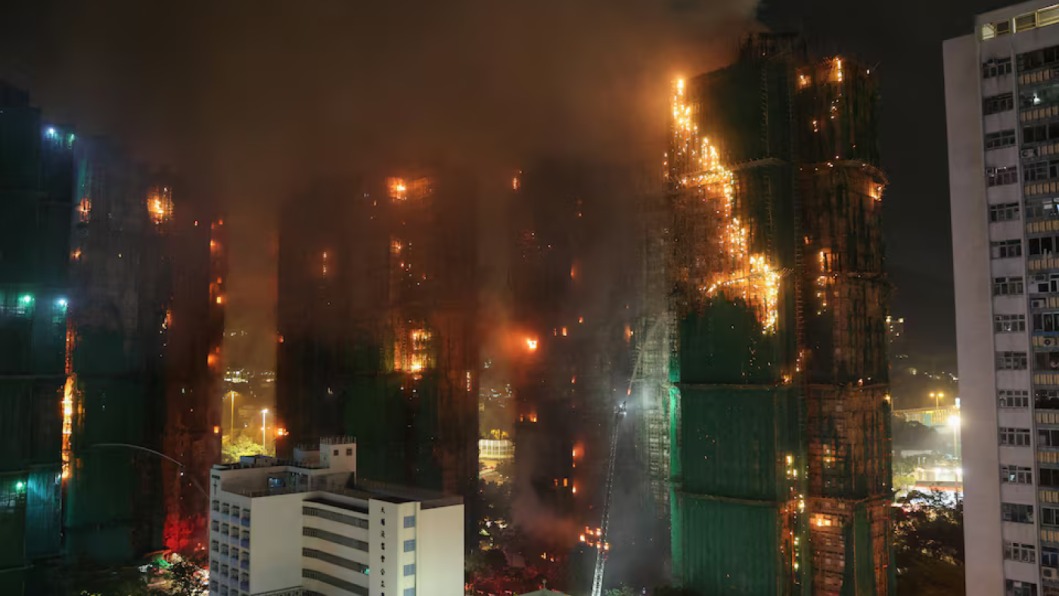
At precisely 2:51 PM local time, residents of Wang Fuk Court, a cluster of eight residential towers rising over 30 floors high, first noticed thick smoke billowing from one of the buildings under renovation. Within minutes, flames shot up the exterior, riding the bamboo scaffolding like a ladder built for fire.
The entire estate was covered in scaffolding and mesh because of ongoing repair work. Witnesses describe a horrifying scene: towering flames roaring up the sides of the building, plastic nets melting and dripping burning debris, and smoke choking stairwells. The fire’s intensity stunned even veteran firefighters.
Residents trapped inside described frantic attempts to escape. For elderly people living alone, for families with young children, and for those on higher floors, escape routes disappeared too quickly. Emergency teams faced collapsing scaffolding, falling debris, extreme heat, and violent fire bursts as they tried rescuing residents.
The blaze continued into the night and well into the next morning, despite the deployment of hundreds of firefighters and dozens of rescue vehicles. By the time the fire was brought under control, it left behind a grim landscape of charred walls, collapsed scaffold poles, and families searching for missing loved ones.
Why Did the Fire Spread So Fast? The Three Culprits Investigators Are Focusing On
As investigators examine the site and interview contractors and residents, three main factors appear to have contributed to the rapid escalation of the blaze:
1. Bamboo Scaffolding – A Cultural Icon With Hidden Fire Risks
Bamboo scaffolding has long been part of Hong Kong’s identity. For decades, it has been used to repair skyscrapers, shopping centers, and residential blocks. It is flexible, lightweight, cheap, and surprisingly strong.
But bamboo is also a natural fuel. When dry as most scaffolding becomes it burns quickly. Under normal circumstances, bamboo scaffolding does not automatically lead to fire spread, but when combined with flammable materials around it, the structure can act like a giant channel for flames to climb vertically.
In the Wang Fuk Court fire, that is exactly what appears to have happened.
Residents reported seeing flames travel up the bamboo poles like a fuse on a firecracker. Once the lower levels ignited, the fire leapt from floor to floor within minutes. This created conditions that overwhelmed residents as well as emergency responders.
Hong Kong’s skyline may be famous for bamboo scaffolding, but this tragedy has intensified calls to rethink its use in densely populated high-rise clusters.
2. Cheap Plastic Mesh and Tarpaulin – “Fuel” Wrapped Around the Buildings
The green or blue nets that wrap around scaffolding have become a familiar sight in Hong Kong. These nets are designed to catch falling debris but many are made of highly flammable plastic.
Video footage and eyewitness accounts show these nets burning fiercely, dripping burning plastic onto the ground, and spreading toxic smoke. Instead of slowing the fire, they helped accelerate it. Their composition often low-quality polyethylene or polypropylene ignites easily and melts rapidly.
These nets, combined with tarpaulins and plastic covering used during renovation, worked as a combustible coat around the buildings. Once the fire reached the mesh, the heat intensified and the fire moved even faster upward.
Investigators now suspect that the construction company may have used substandard, non–fire-resistant mesh to cut costs, a decision that may have turned fatal.
3. Foam Panels, Polystyrene, and Other Hazardous Insulation Materials
One of the more shocking findings involves foam boards and other insulation materials installed on exterior surfaces and elevator lobbies. These materials are notoriously dangerous during fires because they melt, emit toxic gases, and burn at extremely high temperatures.
Residents recalled noticing unusual odors and thick, colored smoke both indicators of burning synthetic insulation. Fire experts have warned for years that foam insulation, if not fire-resistant, can turn a building into a chimney of flames.
In the case of Wang Fuk Court, these foam boards acted as additional fuel. Once they ignited, they contributed to the rapid internal spread that trapped residents inside.
A Disaster Rooted in Neglect and Cost-Cutting?
Authorities have arrested multiple individuals linked to the renovation project on suspicion of gross negligence and manslaughter. Early findings suggest:
- Non–fire-safe materials were knowingly used
- Cheap mesh replaced fire-resistant alternatives
- Foam insulation did not meet safety standards
- Workers may have violated handling and safety protocols
Residents had earlier complained about the renovation quality including unsafe conditions, workers smoking on scaffolding, and delays in supervised inspections. These complaints now seem to paint a picture of systematic neglect and potential corner-cutting.
Fire Safety in Hong Kong: A System Under Pressure
Hong Kong’s dense urban layout makes fire control especially challenging. High-rise towers, narrow corridors, aging infrastructure, and older ventilation systems can all turn a small fire into a catastrophe.
Experts have repeatedly warned that fire safety protocols need dramatic improvement. The Wang Fuk Court blaze proved how thin the margin for error truly is:
- Many buildings still rely on outdated materials.
- Renovation work often prioritizes low cost over safety compliance.
- Fire safety inspections are sometimes infrequent or superficial.
- Residents are unaware of evacuation routes or emergency procedures.
The government has promised a large-scale safety review, but citizens are demanding more than promises they want change.
The Human Cost: Stories of Pain, Loss, and Heroism
Beyond statistics and investigations lie the heartbreaking human stories.
Families standing outside temporary shelters wept as lists of identified victims grew longer. Parents desperately searched for missing children. Residents who escaped watched their homes and decades of their lives turn to ashes.
A firefighter with nearly two decades of service died during rescue operations. His colleagues described him as fearless and selfless, the kind of professional who always took the first step into danger.
Survivors spoke of scrambling through smoke-filled corridors, banging on neighbors’ doors, and carrying elderly residents down staircases that were quickly filling with black fumes.
For the thousands displaced, the path to rebuilding their lives will be long.
What Happens Now? New Rules, New Pressure, and a City Demanding Answers
The Hong Kong government has initiated a full-scale investigation that will take months to complete. But immediate actions are already in motion:
- Emergency inspection of all active construction sites using bamboo scaffolding
- Temporary halt on the use of certain plastic nets until safety checks are completed
- Review of fire safety certifications for all renovation contractors
- Mandatory fire-safety audits at older housing estates
- A possible move toward banning bamboo scaffolding in high-rise residential zones
Safety experts are urging authorities to replace bamboo scaffolding with metal alternatives, enforce strict use of fire-resistant netting, and implement rigorous safety checks even for private renovation projects.
This disaster has exposed weaknesses long ignored. Whether the city will finally address them remains to be seen.
A Tragedy That Must Lead to Transformation
The Wang Fuk Court fire serves as a stark reminder: in a city of vertical living, every material used, every safety rule enforced, and every inspection conducted can make the difference between safety and catastrophe.
Hong Kong now stands at a crossroads. Will it cling to outdated, risky methods to save money or will it honor the lives lost by ensuring no fire ever spreads this fast again? If meaningful reform follows, this horrific tragedy may ultimately spark the improvements the city’s aging infrastructure urgently needs. If not, the lessons of this inferno may be repeated elsewhere with equally devastating consequences.