

|
Getting your Trinity Audio player ready...
|
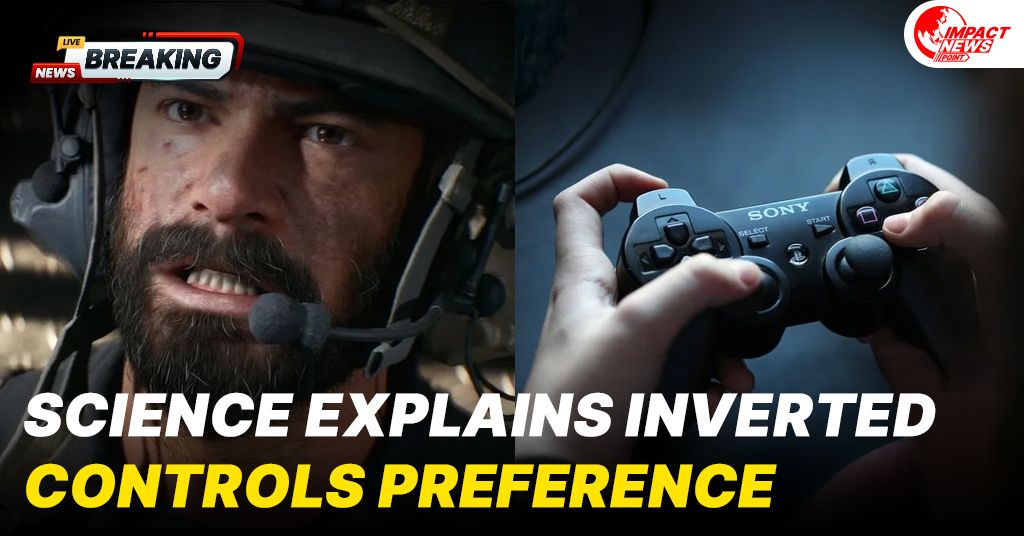
If you’ve ever booted up a video game and instinctively switched your controller to “inverted” controls, you’re not alone and science now reveals why your brain might prefer it that way. A fascinating new study from researchers at Brunel University London dives deep into the neuroscience behind why some players choose to pull back to look up and push forward to look down in games, instead of the classic “normal” setup.
More Than Just Habit or Early Gaming Experiences
For years, gamers assumed control preferences were shaped by habit or the first video games they played. For example, playing flight simulators early on often leads players to invert controls, mimicking pilot behavior. But researchers Dr. Jennifer Corbett and Dr. Jaap Munneke found that it’s not just about habit, it’s how your brain interprets and processes 3D space.
Their study involved surveys, cognitive tests, and experiments like mental rotation tasks and perspective-taking exercises, combined with machine learning to analyze patterns. They discovered that the key factor isn’t your favorite game or console; it’s how quickly your brain can mentally rotate objects and overcome conflicting spatial cues, known as the “Simon effect.”
Fast Mental Rotation Means Less Need to Invert
The research found that gamers who perform faster on mental rotation tasks tend to stick with non-inverted controls. Those slower at these tasks, who sometimes inverted controls, actually demonstrated slightly better accuracy when they used inversion. This challenges conventional thinking that inverted controls mean less skill instead; it appears to be a natural variation in spatial processing.
Why Switching Controls Could Make You a Better Gamer
Interestingly, the study suggests trying the opposite control setting might actually improve your gaming skills. By forcing your brain to adapt to new spatial challenges, you could boost your reaction times and spatial awareness much like how many left-handed individuals in the past were encouraged to use their right hand, sometimes suppressing natural aptitudes. Dr. Corbett encourages gamers to experiment: non-inverters should try inversion, and inverters should try non-inversion for a few hours. This switch could challenge your brain and potentially improve gameplay in popular titles.
Beyond Gaming: What This Means for Other Fields
The implications of this research stretch beyond just video games. Pilots, surgeons, and professionals who rely on precise control and spatial awareness might benefit from understanding their own cognitive preferences. Tuning controls to match how your brain processes space could enhance safety and performance in high-stakes environments. Next time you adjust your controller settings, remember it’s not just a personal preference or habit. Your brain’s way of interpreting 3D space plays a huge role. Trying the alternate control scheme might just unlock a new level in your gaming experience.