

|
Getting your Trinity Audio player ready...
|
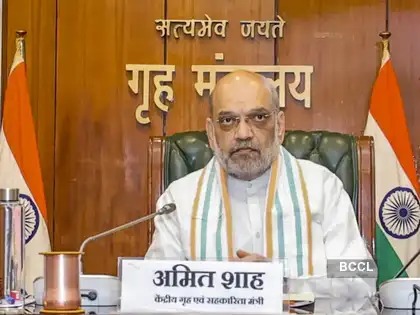
Union Home Minister Amit Shah on Friday outlined a decisive and far-reaching strategy to combat terrorism and organised crime in India, announcing a “360-degree assault” on criminal networks while lauding recent terror investigations in Pahalgam and Delhi as exemplary models of modern policing.
Addressing the Anti-Terrorism Conference in New Delhi, Shah said the investigations into the Pahalgam terror attack and the Delhi blast case demonstrated the growing strength, coordination, and technical capability of India’s security agencies. He described the probes as comprehensive and said they would set new benchmarks in counter-terror investigations.
Referring specifically to the Pahalgam attack, which targeted civilians and tourists in Jammu and Kashmir, the Home Minister stated that the findings of the investigation would expose the larger terror ecosystem operating behind such incidents. He asserted that the evidence collected would strengthen India’s position at international forums and highlight the role of cross-border terror support systems.
Shah also praised the Delhi terror probe, underlining that it reflected seamless coordination between national and state agencies. According to him, these investigations were not isolated successes but part of a larger transformation underway in India’s internal security framework.
In a major announcement, the Home Minister revealed that the government is preparing to launch a nationwide, multi-layered crackdown on organised crime, warning that criminal syndicates often evolve into terror-support structures. He explained that activities such as extortion, kidnapping for ransom, and arms trafficking frequently form the financial backbone of terror networks.
To strengthen enforcement capabilities, Shah announced the introduction of two key national-level digital platforms an Organised Crime Network Database and a Lost, Looted and Recovered Weapons Database. These systems aim to help law enforcement agencies track criminal syndicates, identify patterns, and curb the illegal circulation of weapons across states.
Emphasising the need for uniformity in counter-terror operations, Shah called for closer coordination among state Anti-Terror Squads and urged police leadership to adopt common investigation standards. He stressed that intelligence sharing, real-time data access, and technological integration would be critical in staying ahead of evolving threats.
The Home Minister warned that terrorism is increasingly driven by technology, encrypted communication, and international funding channels. He said India must adopt pre-emptive strategies rather than reactive measures to counter future threats that may not be immediately visible.
Reiterating the government’s zero-tolerance policy, Shah said India’s fight against terror and organised crime has entered a decisive phase, backed by stronger laws, improved intelligence infrastructure, and political resolve. He added that the upcoming measures would target not only perpetrators but also the entire support network enabling criminal and terror activities. Security experts believe the proposed 360-degree strategy could significantly strengthen India’s internal security architecture and serve as a model for counter-terrorism cooperation globally.