

|
Getting your Trinity Audio player ready...
|
India’s oldest mountain range, the Aravallis, has once again become the centre of a nationwide environmental and political storm. A recent government-backed move to introduce a uniform definition of the Aravalli hills, endorsed during ongoing judicial proceedings, has triggered sharp criticism from environmentalists, opposition leaders, scientists, and local communities. Critics warn that the new framework could weaken long-standing protections, potentially opening vast stretches of the fragile ecosystem to mining, construction, and irreversible damage.
What Changed and Why It Matters
At the heart of the controversy lies a technical reclassification of what officially qualifies as the Aravalli range. The new definition relies heavily on measurable elevation and physical relief, rather than ecological continuity. According to experts, this approach risks excluding lower hillocks, ridges, forested outcrops, and connected terrains that may not meet strict height criteria but are ecologically inseparable from the Aravallis.
Environmentalists argue that ecosystems do not function in isolation or by elevation alone. Groundwater recharge zones, wildlife corridors, forest buffers, and climate-regulating green belts extend far beyond a single contour line. A narrowed definition, they say, could strip protection from precisely those areas that quietly sustain northern India’s environmental balance.
Political and Public Backlash
The move has sparked fierce political reactions, particularly in Rajasthan, Haryana, and the Delhi-NCR region, where the Aravallis act as a natural shield against desertification, heatwaves, and air pollution. Opposition leaders have accused the government of attempting to dilute environmental safeguards in favour of commercial interests, calling the redefinition a “policy shortcut with long-term ecological costs.”
Public anger has spilled onto the streets and social media, with citizen groups, activists, and residents launching campaigns demanding stronger protection for the hills. The Aravallis, they argue, are not just geological formations but a lifeline for water security, biodiversity, and climate resilience.
Mining Concerns at the Core
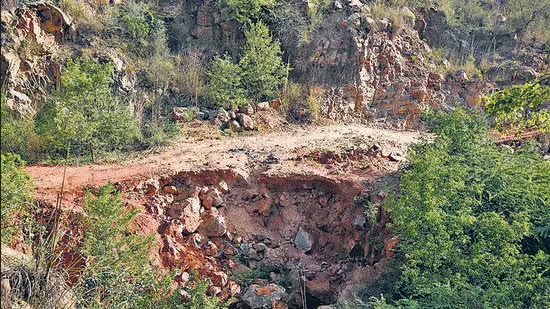
While the government maintains that the exercise aims to bring clarity and scientific precision, critics remain unconvinced. Their primary fear is that a tighter definition could legitimize mining and real estate activity in areas that were earlier treated as part of the Aravalli ecosystem. Illegal mining has long plagued the region, and environmental groups warn that redefining boundaries may make enforcement even harder.
Many experts believe that once land slips out of the “Aravalli” category, it becomes significantly easier for commercial projects to secure approvals, altering landscapes permanently.
Why the Aravallis Are Nationally Critical
Stretching across western and northern India, the Aravalli range plays a crucial role in:
- Preventing desert expansion from the Thar region
- Recharging groundwater aquifers across multiple states
- Acting as a green lung for Delhi-NCR, influencing air quality and temperature
- Supporting diverse wildlife and forest ecosystems
Scientists warn that further degradation could intensify water scarcity, extreme heat, dust storms, and biodiversity loss, with consequences far beyond the immediate region.
What Happens Next
The debate has now moved beyond technical definitions into a broader question of India’s environmental priorities. Activists are demanding a holistic, ecology-first approach, where protection is based on environmental function rather than narrow physical measurements. The government, meanwhile, faces mounting pressure to reassure citizens that economic development will not come at the cost of ecological collapse.
As India grapples with climate stress, water shortages, and urban expansion, the future of the Aravallis may well become a defining test of how the country balances growth with sustainability.