
|
Getting your Trinity Audio player ready...
|
Chhindwara, Madhya Pradesh News
A wave of grief and anger has swept through Madhya Pradesh’s Chhindwara district after the death of at least 11 children, allegedly due to a contaminated cough syrup prescribed by a local doctor. The tragedy has triggered widespread outrage, exposing serious lapses in medical oversight, drug regulation, and healthcare infrastructure.
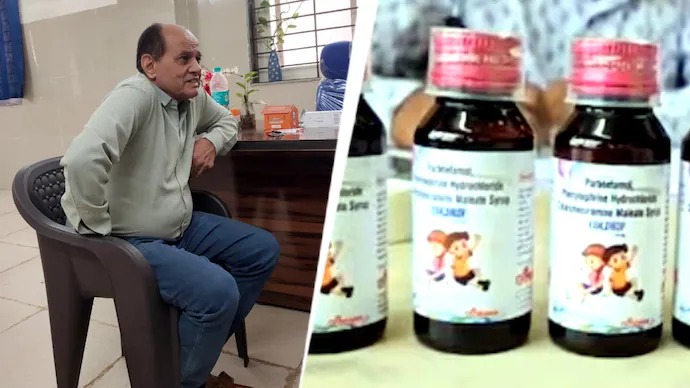
Authorities have arrested Dr. Praveen Soni, a government pediatrician posted at the Parasia Community Health Centre, who has reportedly been prescribing the same cough syrup — identified as Coldrif for nearly 15 years. He insists he had no knowledge that the medicine could be tainted. The arrest followed an FIR naming him and the manufacturers of the cough syrup, Sresan Pharmaceuticals, under charges of culpable homicide not amounting to murder, adulteration of drugs, and violations of the Drugs and Cosmetics Act, 1940.
A Trusted Medicine Turns Deadly
The case came to light after several children, aged between one and five, who were being treated for common cough and fever symptoms, began developing severe renal complications. Parents noticed that their children stopped urinating, suffered swelling, and showed signs of acute kidney failure within days of consuming the syrup. Many were rushed to nearby hospitals, while the more critical cases had to be transferred to Nagpur for emergency dialysis.
Tragically, most of the children could not be saved. The investigation has since revealed that the syrup likely contained diethylene glycol (DEG) or ethylene glycol, both toxic chemicals known to cause kidney and liver failure. Similar contaminants were responsible for earlier mass poisoning incidents in Gambia and Uzbekistan, drawing renewed attention to India’s pharmaceutical quality control failures.
Grief and Anger in Chhindwara
In the small town of Parasia, scenes of mourning have turned into cries for justice. Distraught parents accuse local authorities of negligence and delayed response. Families claim that for days, hospitals failed to recognize the pattern of illness, allowing more children to consume the contaminated syrup.
One bereaved father, holding a photograph of his son, said, “We trusted the doctor. He had treated our children for years. How could this happen with a medicine we have used so many times before?”
The tragedy has also exposed deep-rooted infrastructure gaps. Chhindwara district, despite being one of Madhya Pradesh’s better-performing health zones, has no pediatric dialysis center. Families were forced to travel hundreds of kilometers to Nagpur, often losing precious hours in the process.
State Action and the Expanding Investigation
The Madhya Pradesh government has ordered a statewide crackdown on the cough syrup brand and sealed all remaining stock. The state drug controller has been transferred, and two senior officers from the Food and Drug Administration have been suspended for alleged negligence in monitoring drug quality.
Samples of the suspect medicine have been sent for forensic and toxicological testing at national laboratories, including the National Institute of Virology (NIV) and the Central Drugs Laboratory (Kolkata). Early reports suggest a strong possibility of contamination due to poor manufacturing standards at the pharmaceutical unit.
A Special Investigation Team (SIT) has been formed to trace the drug’s supply chain from production in Tamil Nadu to its sale in Madhya Pradesh and determine where the safety checks failed.
The Doctor’s Defense and the Medical Community’s Outcry
Dr. Praveen Soni, now in custody, maintains his innocence. “I have prescribed this syrup safely for over 15 years,” he told investigators. “I had no reason to suspect it was unsafe.”
The Indian Medical Association (IMA) has condemned the doctor’s arrest, arguing that practitioners should not be made scapegoats for regulatory and manufacturing failures. “A doctor can only prescribe approved drugs available in the market,” the IMA said in a statement. “If a licensed medicine turns out to be contaminated, the accountability lies with the system that cleared it for sale.”
This perspective has sparked public debate about where medical liability begins and ends — with the prescriber or the producer.
A Wake-Up Call for India’s Drug Regulation
This tragedy is not the first of its kind. India’s pharmaceutical exports have faced global scrutiny in recent years after DEG-related deaths were reported in Gambia, Uzbekistan, and Cameroon. Yet, despite these warnings, regulatory vigilance at the domestic level remains inconsistent.
Experts believe that India’s vast network of small and medium-sized pharmaceutical manufacturers often escapes stringent quality testing due to resource limitations and bureaucratic inefficiency. The Chhindwara incident, they argue, is a grim reminder that even well-intentioned doctors and parents can become victims of a weak oversight system.
The Madhya Pradesh government has announced compensation for the affected families and promised swift justice once the final lab reports confirm the cause of deaths. Chief Minister Mohan Yadav has called the incident “a national-level failure that must never be repeated.” Meanwhile, public outrage continues to mount, with families demanding that both the pharmaceutical company and regulatory authorities be held equally accountable. The story of Chhindwara has reignited a critical conversation about medicine safety, accountability, and the urgent need for stronger checks within India’s healthcare system.