
|
Getting your Trinity Audio player ready...
|
By Impact News Point
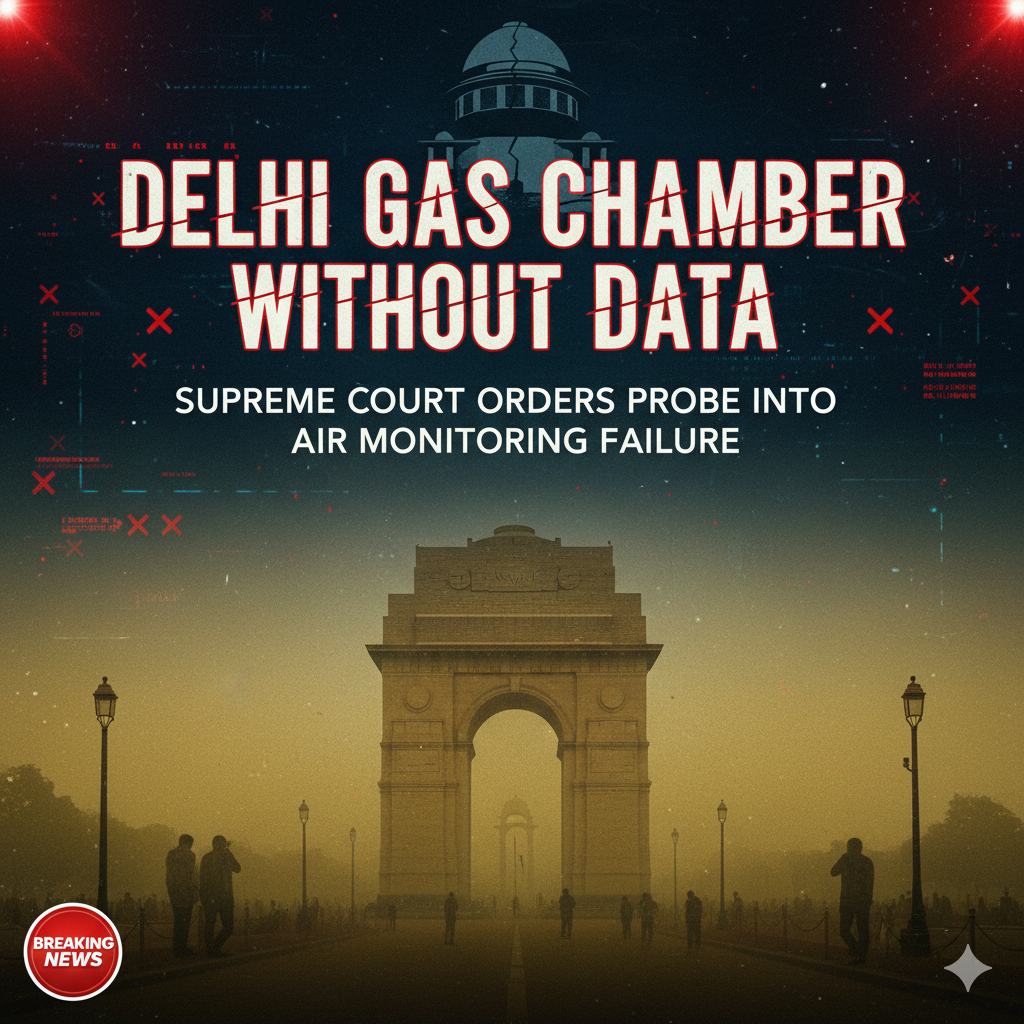
Delhi’s Air Pollution Crisis Worsens But the Monitors Went Silent
At a time when Delhi’s air quality dipped to hazardous levels, shocking revelations emerged in the Supreme Court: most of the city’s air quality monitoring stations were not working.
According to the Court-appointed amicus, only 9 out of 37 air-monitoring stations were operational during Diwali, the very period when pollution peaks each year.
The revelation has sparked outrage, as the system responsible for tracking Delhi’s deadly smog was effectively “blind” when citizens needed it most.
Supreme Court’s Stern Warning
During a hearing on Delhi’s worsening pollution, the Supreme Court expressed deep concern over the apparent failure of monitoring systems and directed the Commission for Air Quality Management (CAQM) and the Central Pollution Control Board (CPCB) to submit a detailed report.
The Court demanded an explanation on:
- Why the majority of stations were defunct.
- What immediate measures are being taken to restore them.
- How authorities plan to prevent such failures in future.
The bench remarked that without accurate data, the fight against pollution becomes meaningless, comparing the situation to “fighting in the dark.”
Delhi Breathes Toxins, But Without a Warning System
For Delhi’s 3 crore residents, air pollution is an annual nightmare but this year, it turned even grimmer.
Without proper data from monitoring stations, officials had no real-time visibility of toxic levels, making it impossible to implement emergency steps like school closures or traffic restrictions in time.
Doctors have already warned that children, the elderly, and asthma patients are the first to suffer when pollution spikes go unnoticed.
Residents described the air as “thick, choking, and impossible to breathe,” yet authorities appeared to have little idea of just how bad it had become.
The Technology That Failed an Entire City
Delhi’s network of air-quality monitors is meant to track pollutants like PM2.5 and PM10, and alert the government when thresholds are crossed.
However, many of these stations have reportedly been malfunctioning for months due to poor maintenance, lack of funds, and bureaucratic negligence.
Environmental activists argue that this breakdown isn’t a technical glitch, it’s a systemic failure.
“It’s like having fire alarms that don’t work during a fire,” said one environmentalist. “Without functioning monitors, how will the government know when to act?”
What’s at Stake
The incident has brought to light three major risks for Delhi and other polluted cities:
- Public Health Emergency:
People are breathing in hazardous air without timely warnings or protective advisories. - Policy Paralysis:
When data is missing, emergency plans like the Graded Response Action Plan (GRAP) can’t be activated effectively. - Accountability Crisis:
Citizens question whether the agencies meant to protect public health are functioning with any urgency.
Supreme Court Steps In
The Supreme Court’s intervention is now being seen as the only ray of accountability in a system that has grown numb to pollution headlines.
The bench has directed that the CAQM and CPCB must submit an affidavit detailing station-wise functionality, reasons for breakdowns, and a timeline for full restoration.
It also hinted that stronger penalties could be imposed if negligence is found.
The next hearing is expected to review the submitted reports and may lead to stricter nationwide guidelines for air-monitoring maintenance.
Voices from the Ground
Residents and health experts alike have expressed anger and disbelief.
“When even air monitors stop working, it means we’re not just breathing poison, we’re doing it blindly,” said a schoolteacher in South Delhi.
Doctors from major hospitals have also called for the installation of backup sensors and public awareness alerts, emphasizing that real-time air data can save lives by allowing vulnerable citizens to take precautions sooner.
A City Gasping for Accountability
Every winter, Delhi’s skyline disappears behind a curtain of grey and with each passing year, the excuses grow darker too.
This time, the crisis is not only about what’s in the air but also about what isn’t being measured.
Without reliable data, the government cannot manage air pollution and without accountability, citizens are left helpless.
The capital’s air has become a silent killer, and now even the systems meant to warn people are going silent.