
|
Getting your Trinity Audio player ready...
|
A Strong Rebuke at the UN
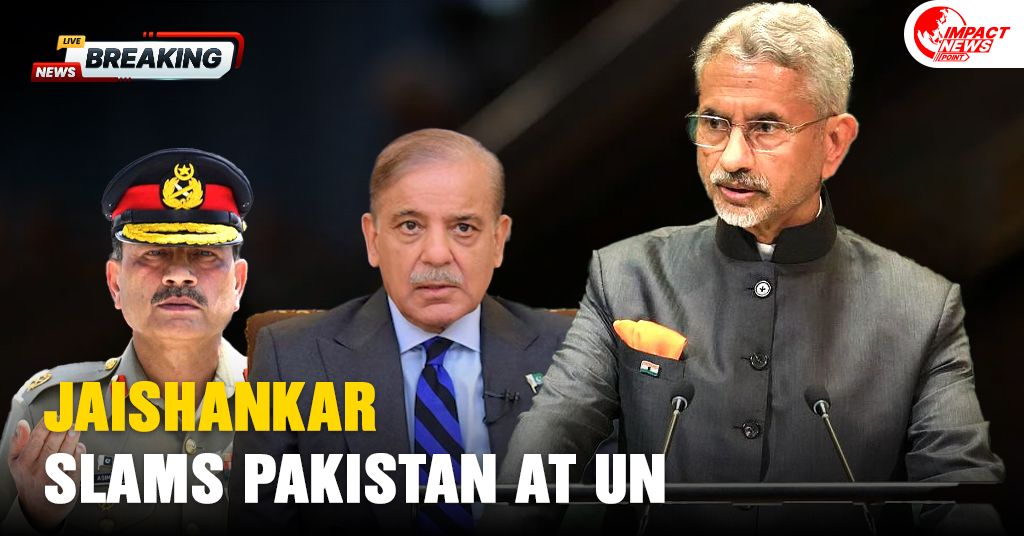
In a forceful address to the 80th United Nations General Assembly in New York, India’s External Affairs Minister Dr. S. Jaishankar launched a scathing attack on Pakistan, calling it the “epicentre of global terrorism”. Citing the recent Pahalgam attack that killed 26 tourists, Jaishankar said that decades of major international terrorist operations have been traced back to “one country,” a pointed reference to India’s neighbor.
“When nations openly declare terrorism as state policy, when terror hubs operate on an industrial scale, and when terrorists are publicly glorified, such actions must be unequivocally condemned,” Jaishankar told world leaders, drawing global attention to India’s long-standing concerns.
The Pahalgam Attack and Its Aftermath
Jaishankar’s remarks came against the backdrop of the recent attack in Pahalgam, Jammu & Kashmir, which left dozens dead and shocked the nation. The minister underscored that incidents like these are not isolated but part of a larger pattern of cross-border terrorism supported and financed systematically.
He reaffirmed India’s right to defend its citizens and referred to Operation Sindoor, highlighting how India brought perpetrators of terror to justice.
Financing Terrorism and Global Responsibility
In one of the strongest passages of his speech, Jaishankar stressed that terror financing must be choked at its source. “Relentless pressure must be applied on the entire terrorism ecosystem. Those who condone nations that sponsor terror will find it comes back to bite them,” he said.
His statement was not only directed at Pakistan but also served as a warning to countries and institutions that overlook or tolerate such sponsorships for geopolitical convenience.
Pakistan in the Crosshairs
Without naming Pakistan directly, Jaishankar left little ambiguity when he said, “For decades now, major international terrorist attacks are traced back to that one country. UN’s designated lists of terrorists are replete with its nationals.”
The remarks resonated strongly, especially as they came just hours after India’s UN representative, Petal Gahlot, slammed Pakistan’s Prime Minister Shehbaz Sharif for glorifying terrorism during his own UN address.
Global Reactions and India’s Stand
Jaishankar’s strong words have sparked international debate. While many countries have expressed solidarity with India in combating terrorism, others have chosen silence, wary of geopolitical sensitivities in South Asia.
For India, however, the message was clear: terrorism cannot be compartmentalized or justified, and the global community must unite in isolating nations that perpetuate it.
A Consistent Indian Position
India’s foreign policy has long emphasized zero tolerance for terrorism, but Jaishankar’s speech was notable for its sharpness and timing. Coming at a moment when global conflicts have already heightened security concerns, his words underscored India’s determination to hold Pakistan accountable at the highest international forum. By linking the Pahalgam tragedy with a broader pattern of state-sponsored terror, Jaishankar reminded the world that the threat is not confined to India’s borders, it is a global danger demanding global action.
Parting Thoughts
A Call for Accountability
As the UNGA session continues, Jaishankar’s remarks have reinforced India’s image as a nation that confronts terrorism with clarity and resolve. His warning that those shielding terror-sponsoring nations will ultimately face the consequences adds urgency to an issue often mired in political double standards. For India, the fight is not just about defending its people in Kashmir but about ensuring that terrorism loses its legitimacy as a political tool on the world stage.