

|
Getting your Trinity Audio player ready...
|
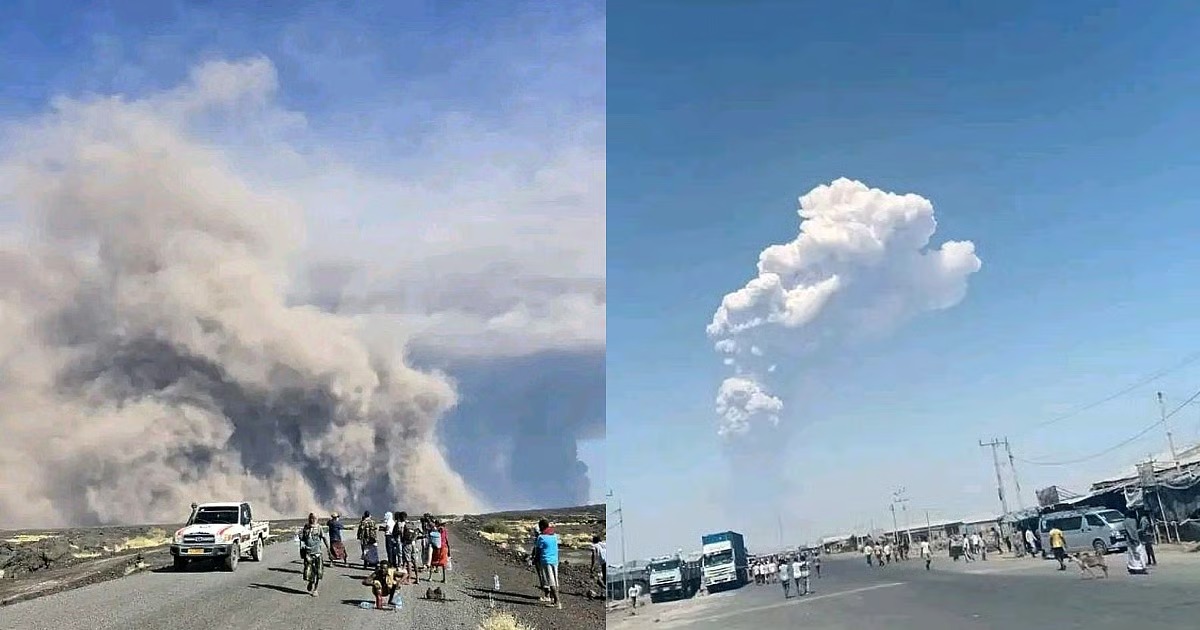
In a rare and powerful geological event, Ethiopia’s Hayli Gubbi volcano erupted after more than 10,000 years of dormancy, sending a towering ash plume across continents and disrupting international aviation from Africa to South Asia. The eruption, which began on Sunday, created a massive cloud rising nearly 14 km into the sky, powerful enough to drift into Indian airspace and trigger major flight advisories.
A Volcano Awakens After Millennia
Hayli Gubbi, located in Ethiopia’s Afar region, sits along the geologically active East African Rift, a zone where tectonic plates slowly pull apart. Despite this, the volcano had shown no known activity in thousands of years. Its sudden eruption stunned geologists and triggered an immediate response from global volcanic monitoring agencies.
Satellite images captured explosive activity and vast columns of ash spreading outward from the region. The surrounding villages, including those in Afar, reported layers of ash settling on homes, water sources and grazing lands. Although the region is sparsely populated, residents experienced coughing, visibility issues and contaminated livestock resources. Local authorities have currently reported no major casualties.
Ash Cloud Travels Across Continents
Following the eruption, high-altitude winds transported the ash cloud eastward over the Red Sea, affecting Yemen and Oman before pushing toward the Arabian Sea and reaching India. The plume then drifted across western, northern and northwestern India, including states such as Gujarat, Rajasthan, Delhi, Punjab and Haryana.
Meteorological authorities confirmed that the plume traveled at extremely high altitudes around 45,000 feet and therefore did not significantly impact ground-level air quality. However, its presence at commercial flight levels created serious safety concerns for aviation.
Airlines Cancel Flights as DGCA Issues Advisory
India’s civil aviation regulator, the Directorate General of Civil Aviation (DGCA), quickly issued an advisory instructing airlines to avoid all volcanic ash-affected air routes and flight levels. Pilots were informed to expand fuel margins, consider alternative routings and report any anomaly in engine or cockpit performance.
Airlines across India began cancelling and diverting flights. Air India cancelled more than 10 international routes on November 24 and 25, rerouting several Europe- and Middle East-bound services. Akasa Air suspended operations to multiple Gulf destinations, citing high-altitude ash interference.
Delhi’s Indira Gandhi International Airport witnessed multiple delays and cancellations as the ash plume passed overhead.
Volcanic ash poses a severe risk to aircraft, including engine failure, windshield abrasion, sensor malfunctions and loss of visibility risks that airlines cannot compromise on.
Ash Expected to Clear From Indian Skies
Weather models suggest the ash plume is expected to fully exit Indian airspace within a short period as it continues drifting toward China. Authorities are monitoring the situation continuously, while aviation agencies across Asia remain on alert for any shifts in wind direction or renewed volcanic activity.
Scientists on High Alert
Because Hayli Gubbi had remained silent for over 10,000 years, geologists are now intensifying monitoring efforts. The eruption raises questions about whether the volcano is entering a new active phase or if this was an isolated event caused by deep-mantle pressure build-up within the Afar Rift.
Environmental teams in Ethiopia are also assessing long-term impacts on water bodies, livestock health and soil quality in the affected region.
Why This Eruption Matters Globally
- A single eruption disrupted flight corridors across Africa, the Middle East and India, showing the vulnerability of international aviation to remote natural events.
- High-altitude ash can linger for days and affect climate patterns, flight safety and atmospheric chemistry.
- Rare geological activity in tectonically active regions highlights the interconnectedness of global weather and transportation systems.
Parting Thoughts-
The Hayli Gubbi eruption is one of the most significant volcanic events in recent years, not only because of its scale but because a long-dormant volcano reawakened with powerful force. From Ethiopian villages to Indian skies, its impact spanned thousands of kilometres, reminding the world how a single natural event can ripple across nations, skies and economies.