

|
Getting your Trinity Audio player ready...
|
London:
In dusty basements, university archives, and old office drawers, thousands of floppy disks lie abandoned tiny plastic squares that once held the digital dreams of a generation. Inside them are family letters, scientific discoveries, unpublished novels, and early artworks. But there’s one big problem: no one can read them anymore.
The once-reliable floppy disk, the symbol of the early digital age, has become a fragile time capsule. The drives to read them are disappearing, and the magnetic material they rely on is slowly deteriorating. If no one acts soon, decades of digital history could vanish forever.
The Fragility of Our Digital Past
The floppy disk was revolutionary in its time. From the 1980s to the early 2000s, it stored everything from school projects, research papers, photos, and software. But time hasn’t been kind to them.
The disks degrade, the data weakens, and the devices that once brought them to life now exist only in museums or private collections. Even when a disk survives, the software used to open its files often doesn’t. What good is an old WordPerfect document if the program to read it has long been extinct?
Digital archivists warn that while people think of digital information as permanent, it’s actually more fragile than paper. A handwritten diary from 1920 can still be read today, but a digital file from 1995 might already be lost.
Meet the Digital Rescuers
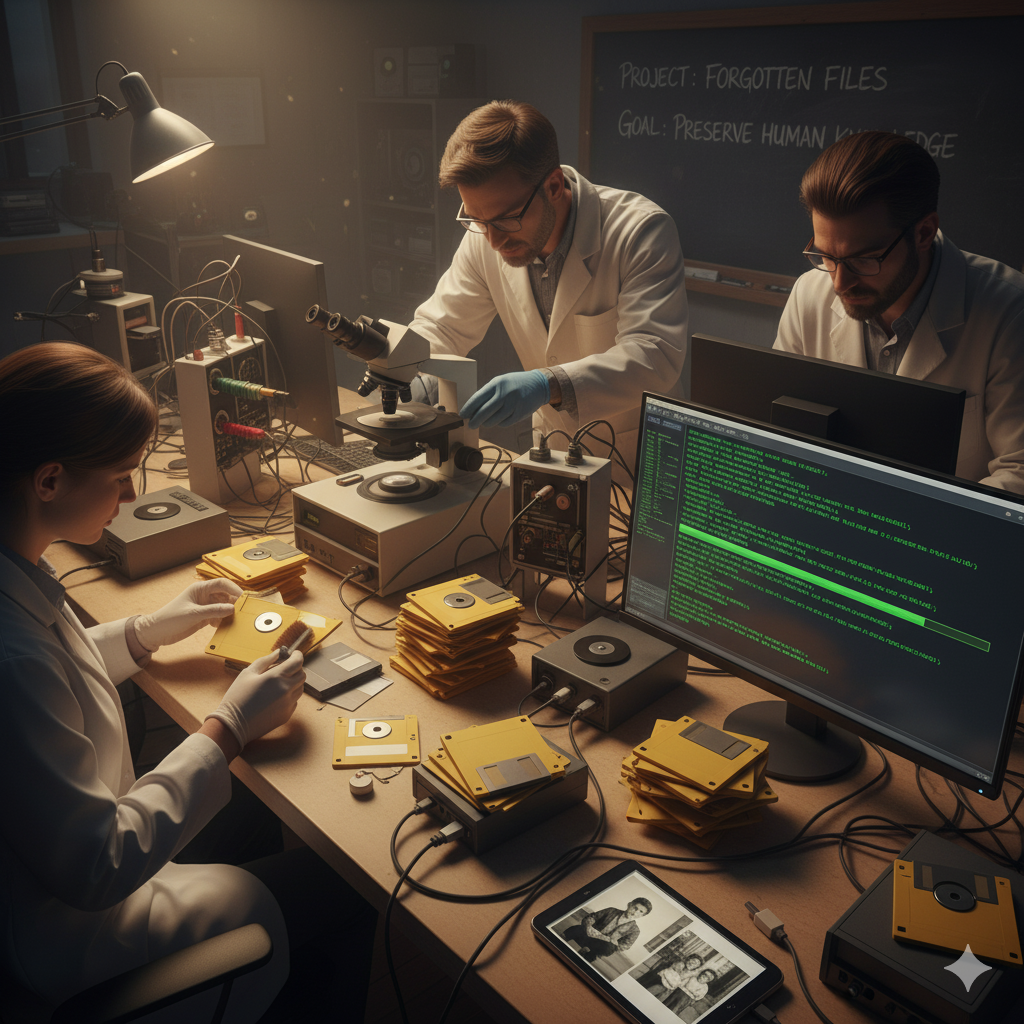
All over the world, a small but passionate community of digital preservationists is fighting against time. They call themselves “data archaeologists,” and their mission is simple but monumental to recover what’s left.
Armed with vintage hardware, soldering tools, and advanced software, they work like detectives, reviving old floppy drives, scanning disk surfaces, and piecing together corrupted files.
Instead of brushing sand off fossils, they scrape data off fading magnetic surfaces. Each recovered byte could contain a piece of history, a forgotten poem, a groundbreaking experiment, or the first digital designs of a young artist.
One preservation expert described it best: “Every floppy is like a locked chest. Sometimes, it opens right up. Other times, it fights you for every bit of its story.”
The Science Behind the Save
Modern tools make it possible to rescue even badly damaged floppies. High-precision readers now extract microscopic traces of magnetic signals, bit by bit, while software reconstructs the missing information.
Once a disk’s data is captured, programmers use emulators virtual versions of old computers to reopen the files exactly as they looked decades ago. From there, the content can be converted into modern formats and safely archived.
Museums, universities, and digital libraries are joining hands to build repositories of recovered data safe digital homes where old files can live again.
Why It Matters More Than You Think
Saving floppy disks isn’t about nostalgia; it’s about preserving human knowledge.
- Scientists may rediscover lost research data from early experiments in physics, biology, or astronomy.
- Historians could uncover letters, essays, and artworks that capture the voice of an era.
- Archivists are even recovering early digital music and games, revealing how creativity evolved when computing was young.
Each recovered file tells a story of curiosity, invention, and the fragile hope that our creations might last forever.
A Race Against Time
The challenge is urgent. Magnetic data decays with age, and many disks are already unreadable. The archivists know they are in a race not just against technology, but against nature itself.
Once the data fades beyond recovery, it’s gone for good like a burned manuscript or a forgotten melody. That’s why the people behind this mission see themselves as caretakers of the digital age, trying to bridge the gap between yesterday’s innovation and tomorrow’s memory.
As one preservationist put it:
“We saved the past on floppies. Now, it’s up to us to save the floppies themselves.”