
|
Getting your Trinity Audio player ready...
|
Bareilly News
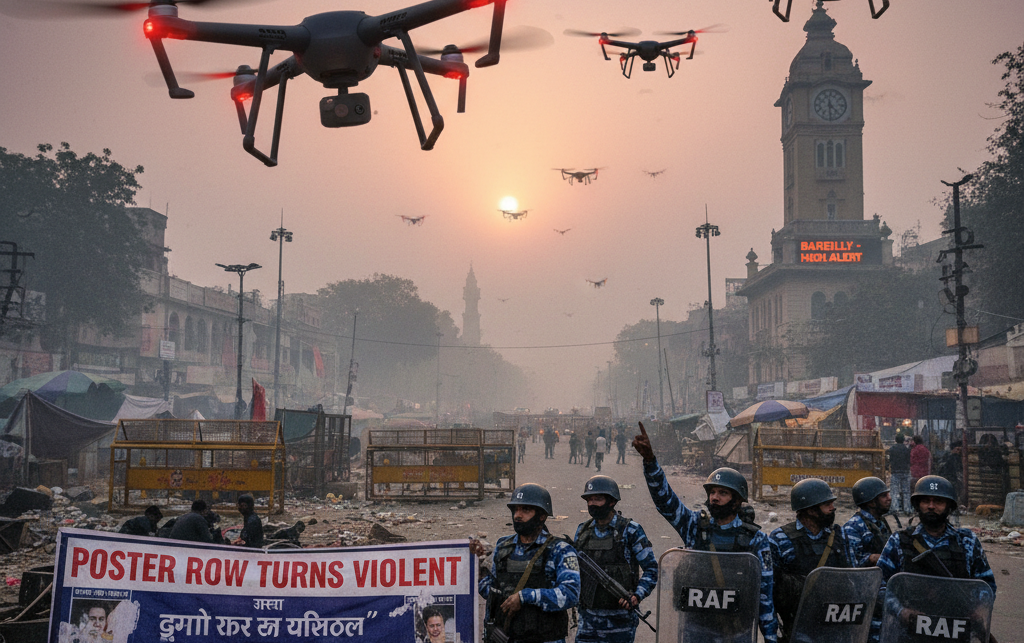
Bareilly has become the epicenter of tense civil disturbance following a controversial “I Love Muhammad” poster row. The local administration, citing heightened risk of unrest, has deployed drones, mobilized armed forces, and imposed a 48-hour suspension on internet, broadband, and SMS services in the district.
What Happened and Why the Crackdown?
On September 26, hundreds of people gathered near a mosque in the Kotwali area after Friday prayers to protest the cancellation of a planned demonstration tied to the poster controversy. The gathering escalated into violent clashes: stones were hurled, police were injured, and multiple arrests were made. Authorities say some of the protestors came prepared, aggravating tensions.
In response, security has been drastically ramped up. Four districts in the Bareilly division are now on high alert. Drones are patrolling overhead while forces from the Provincial Armed Constabulary (PAC), Rapid Action Force (RAF), and local police coordinate street deployments.
The Internet Shutdown & Communication Freeze
To counter the spread of rumors and misinformation, mobile internet, SMS, and broadband services have been suspended from 3 pm on October 2 through 3 pm on October 4. Officials argue that social media platforms and messaging apps could be misused to incite further communal violence.
The suspension is broad and strict. Reports say that certain political figures were prevented from leaving their homes or traveling to Bareilly during this period, raising questions about civil liberties amid security measures.
Arrests, FIRs & Rising Tensions
By now, more than 80 individuals have been arrested in connection with the violence. FIRs have been filed naming hundreds of named and unnamed persons. Among those detained is cleric Tauqeer Raza Khan, head of Ittehad-e-Millat Council, who had appealed for the protest. Police say evidence suggests he may have been involved in organizing the unrest.
Authorities claim that weapons, stones, and incendiary material were recovered at protest sites. Some of the accused were injured during police encounters, and investigations are ongoing.
Local Life Disrupted
The streets of Bareilly’s Old City, once bustling with trade, now lie eerily quiet. Shops are open but devoid of customers. Livelihoods tied to daily footfall — small merchants, bookshops, bicycle repairers — report sharp losses. Numerous houses in affected areas remain locked, their occupants anxious and uncertain.
Families of those arrested complain of denial of access and lack of clear communication from authorities. The administration has meanwhile announced that demolition or sealing actions may follow in zones linked to violence, escalating fears among residents about arbitrary action.
What to Watch Next
- Whether the government extends the internet blackout or eases curbs earlier
- Judicial review or legal challenges to the communication suspension
- Evidence from forensic, video, and witness testimonies to clarify how the violence was coordinated
- The response from human rights and civil liberties groups over arrests and restrictions
- Conditions for arrested individuals and updates on cases against clerics and protestors
Bareilly is under strain. What began as a poster row now tests the limits between security enforcement and democratic rights. In the coming days, authorities must tread carefully: preserving peace is essential, but so is ensuring that justice and transparency prevail.