
|
Getting your Trinity Audio player ready...
|
Silicon Valley
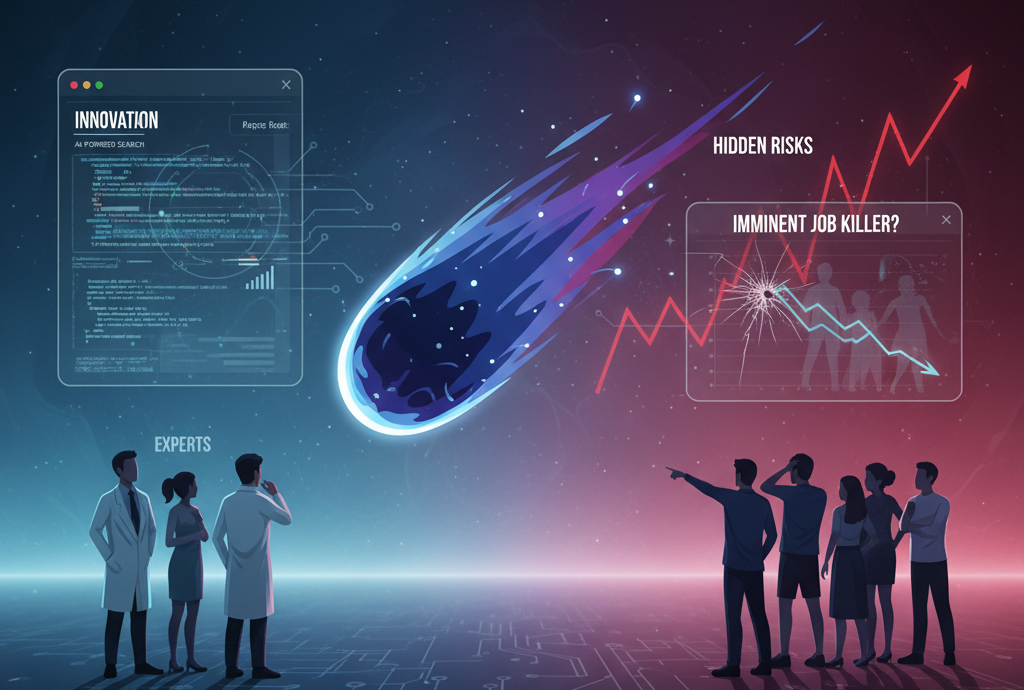
When Perplexity AI launched its AI-powered Comet browser, the world of technology and business cheered for another leap in artificial intelligence. But behind the sleek interface and grand promises of efficiency lies a growing unease Is this the beginning of a slow human replacement in digital workspaces?
While Perplexity’s CEO Aravind Srinivas proudly claims that Comet can help companies “save on wage bills” and “hire fewer people,” critics say the message reveals a troubling future — one where AI doesn’t just assist workers but gradually renders them unnecessary.
“Save on Hiring” – But at What Human Cost?
The idea of using AI to reduce hiring has set off alarm bells across multiple sectors. Experts warn that the same technology being marketed as a productivity booster may, in reality, accelerate job losses in roles involving research, data entry, content creation, marketing, and even basic coding. Tech labor unions and AI ethicists argue that the underlying business motive is clear profit through downsizing. “Every time a company says AI will ‘cut hiring,’ it means human livelihoods will pay the price,” says one digital labor researcher. In an era already witnessing mass layoffs in tech, tools like Comet could become corporate justifications for shrinking teams further under the guise of efficiency.
Automation Overload: The Dark Side of ‘Productivity’
While Perplexity promises that Comet will assist employees, the fine line between assistance and replacement is getting blurrier. As AI learns to perform multiple knowledge-based tasks — summarizing documents, writing reports, managing emails humans are left with diminishing scope to add value.
This could lead to:
- Overdependence on AI for strategic decision-making
- Erosion of human skills like research, reasoning, and creative writing
- Mass deskilling across digital professions
Tech critics warn that AI-driven automation is advancing faster than society’s ability to adapt or reskill. Once companies realize that the browser can handle what entry-level analysts or assistants do, those roles could vanish altogether.
Comet Browser Privacy and Surveillance Concerns
There’s also growing skepticism about data privacy. Since Comet operates as a cloud-based AI system, every search, prompt, and task performed could theoretically be logged or analyzed.
For companies, this raises a serious red flag can confidential data, financial reports, or internal communications be trusted to an AI service operating on external servers?
Data protection experts caution that without clear transparency, Comet could expose users to data mining, profiling, or corporate espionage risks.
The Question of Accuracy
Despite Perplexity’s marketing, AI systems are still prone to hallucinations confidently producing false or misleading information. In corporate use, this can be catastrophic.
Imagine an AI browser drafting reports, summaries, or financial notes based on incorrect data the consequences could range from lost clients to legal liability. The human layer of judgment, which AI can’t replace, is precisely what many companies might risk removing in pursuit of efficiency.
The Ethical Dilemma of “AI Replacing Humans”
Perhaps the most uncomfortable part of this debate is the moral question it raises: Should innovation be celebrated when its direct consequence is the displacement of people?
The narrative of “productivity through automation” may sound appealing, but critics say it hides a colder truth: the gradual commodification of intelligence itself.
AI doesn’t tire, doesn’t demand salaries, and doesn’t make human errors but it also doesn’t innovate emotionally, empathize, or create meaning. The danger, many argue, is that in optimizing for efficiency, we risk hollowing out the very essence of human creativity.
Expert Voices of Caution
Leading technologists are already voicing warnings about uncontrolled AI adoption:
- Sam Altman of OpenAI and Geoffrey Hinton (the “Godfather of AI”) have repeatedly urged for regulatory frameworks to prevent large-scale displacement.
- Labor economists predict that without balance, AI-led automation could widen inequality, creating a divide between AI-literate elites and a displaced workforce.
If browsers like Comet become mainstream in business workflows, that warning might materialize sooner than expected.
Innovation Needs Boundaries
The Comet browser might be revolutionary, but revolutions often come with casualties. As Perplexity positions itself as the next frontier of AI-driven productivity, it must also answer the uncomfortable question: At what cost? Efficiency without empathy can destabilize industries, hollow out human jobs, and deepen digital dependence.
Unless companies and regulators act now, the promise of AI as an assistant could swiftly turn into a reality where humans assist AI.