
|
Getting your Trinity Audio player ready...
|
Patna, Bihar:
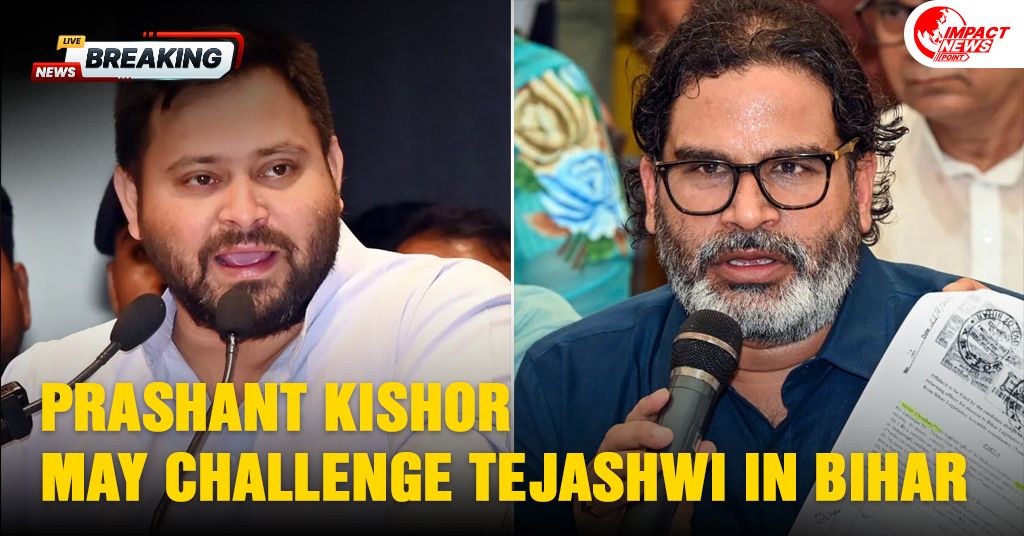
In a surprising turn in Bihar’s political landscape, strategist-turned-politician Prashant Kishor (PK) has dropped strong hints that he might contest the upcoming assembly elections from Raghopur, the stronghold of Tejashwi Yadav. As he toured the region, PK suggested that Tejashwi could face a fate similar to what Rahul Gandhi experienced in Amethi, a dramatic electoral setback, despite being in a party bastion.
During his visit, PK spoke openly, saying he would assess public sentiment before finalizing his decision. He declared that the verdict of the people of Raghopur would guide which candidate should contest. If he enters the race, he said, Tejashwi may be forced to contest from two constituencies, just as Rahul Gandhi once did. The comparison is a clear warning: even strong political legacies can be upended when voters decide differently.
Raghopur is no ordinary seat. It has been deeply linked to the Yadav family legacy Lalu Prasad Yadav and Rabri Devi held it multiple times, and Tejashwi has also won it twice (in 2015 and 2020). The constituency has seen historic importance in Bihar politics and has been used as a symbol of the Yadav clan’s strong influence.
PK’s political vehicle, the Jan Suraaj Party, recently released its first list of 51 candidates contesting the upcoming elections on November 6 and 11. The list is wide-ranging: from artists and doctors to public servants, representing various communities and backgrounds. The inclusion of prominent names and diverse representation signals that the party is aiming to make a strong impact in this election cycle.
In this charged atmosphere, Bihar is now watching closely: Will PK officially take on Tejashwi in Raghopur? Will Tejashwi stick to his traditional seat or spread out? Can the legacy of the Yadav family withstand the challenge? And could Bihar’s electorate, once again, deliver political surprises that shake long-held assumptions?
Crimelines
1. Odisha Medical Student Allegedly Gang-Raped Near Durgapur College, Investigation Underway
Durgapur, West Bengal
A deeply distressing incident has shaken local communities: a second-year medical student from Odisha was allegedly gang-raped just outside a private college campus in Durgapur. The case is now under police scrutiny, with both public anger and demands for justice mounting.
The student had gone out with a friend to dine. After her friend left, she was reportedly approached by multiple men who snatched her mobile phone, dragged her into a more secluded area near the campus, and assaulted her. She later escaped and lodged a complaint with the authorities.
Local police have registered a formal case and initiated both investigative and forensic work at the scene. They are collecting evidence, taking the victim’s statement, and working to identify the suspects. The National Commission for Women (NCW) is also expected to send a team to meet the student and her family, ensuring their protection and monitoring the progress of the case.
Outrage, Political Response, and Calls for Action
News of the crime has sparked widespread outrage across the state and beyond. Citizens, activists, and women’s rights groups have voiced their anger, demanding swift action and stronger safeguards for women. Many have expressed that no person should live in fear while pursuing education or daily life.
The Bharatiya Janata Party (BJP) has joined the chorus of condemnation, accusing the Mamata Banerjee-led West Bengal government of failing to ensure safety. The party claims that the state has become a “safe haven for rapists,” pointing to repeated incidents as signs of systemic failure.
In contrast, the Trinamool Congress (TMC) has cautioned against turning the tragedy into a political battleground. TMC leaders have stated they support full legal action, but insist that handling the case responsibly is more important than public posturing.
Meanwhile, the Odisha state government has also stepped in, extending its support to the student and her family. They have offered assistance and have been in touch with West Bengal authorities to ensure the case proceeds without delay.
The Bigger Picture: Women’s Safety and Trust in Justice
This alleged assault is not just an isolated incident it raises urgent questions about how safe educational and public spaces are for women. It also tests the faith people have in law enforcement and the judicial system.
Many believe that justice must be visible and fast. Long delays, lack of transparency, or mishandling can deepen the trauma for survivors and erode public trust. And when leadership across parties responds with empathy and action rather than blame games, it reinforces the idea that protecting citizens comes before politics.
For now, all eyes are on Durgapur. Will the police identify and arrest the accused? Will the case be pursued diligently? And will this tragic event trigger meaningful reforms for women’s security across India?