
|
Getting your Trinity Audio player ready...
|
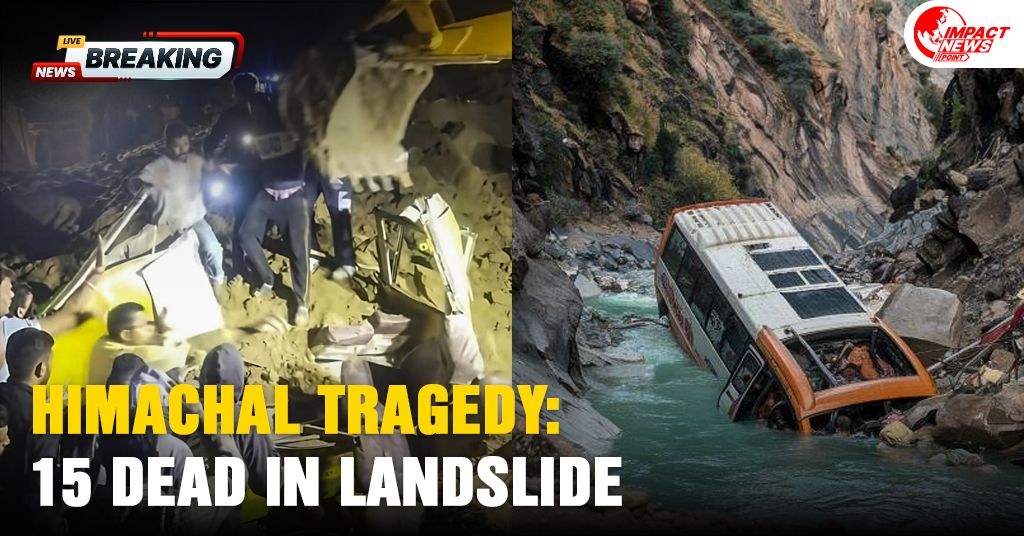
A quiet evening in Bilaspur turned into a nightmare when a massive landslide struck a private bus, burying it under tons of earth and rock. The tragedy unfolded around 6:30 pm near the Bhalughat (Bhallu Bridge) region in the Jhandutta subdivision, when the vehicle was en route from Marottan to Ghumarwin.
Eyewitnesses say the hillside had already been weakened by persistent rainfall, and in a sudden deluge of debris, the slope gave way sending boulders hurtling onto the bus’s roof. The vehicle, carrying an estimated 28–35 passengers, was crushed in a matter of moments.
By nightfall, rescue teams had pulled out 15 lifeless bodies from the wreckage. Three people, gravely injured and trapped in the wreckage, were rescued and rushed to hospitals in nearby villages. Efforts are ongoing, with fears that more may yet be buried under the rubble.
Rescue in the Dark
Responding swiftly, local police, disaster response forces, and district officials raced to the site. JCBs and other heavy machinery were brought in to clear the debris and carefully dismantle the crushed sections of the bus.
Officials say that in some stretches, the boulders were so massive that rescuers had to chip away and lift layers gradually, working by torchlight as hours passed. The terrain, still soggy and unstable, continues to pose a grave danger to those on the ground.
The local administration has declared the operation one of “war footing,” and senior state leaders remain in constant contact to monitor developments.
Political Response & Relief Promises
News of the tragedy rippled fast. The Chief Minister of Himachal Pradesh expressed deep grief over the loss of life and directed authorities to speed up relief efforts and extend all possible medical aid to the injured. At the national level, the Prime Minister conveyed condolences, describing the loss as deeply saddening. He also declared an ex-gratia compensation of ₹2 lakh for each deceased and ₹50,000 for every injured person, to be disbursed from the Prime Minister’s National Relief Fund. Local legislators, too, visited the scene, comforting distraught families, coordinating with administrations, and overseeing rescue logistics firsthand.
A Region Under Strain
This tragedy comes at a time when Himachal Pradesh’s hill slopes are already unstable. Heavy and recurring rainfall over recent days has saturated the soil, triggering multiple landslides across the region. In Bilaspur and nearby districts, flash floods and landslides had already caused road blocks, property damage, and disruptions to daily life. Experts warn that with monsoon seasons intensifying in recent years, the risk to hillside communities and transport routes remains high. Weak terrain, unchecked deforestation, and unplanned construction in hilly zones are often cited as aggravating factors in such disasters.
What Lies Ahead
Now, the focus is on two fronts:
- Rescue & Recovery: Teams continue to scour the site for survivors. Every minute counts in shifting debris safely and reaching potential victims.
- Investigation & Prevention: Authorities likely will launch an inquiry to pinpoint exact causes whether it was natural erosion, faulty land management, or a combination of both. That must feed into long-term measures: better slope stabilization, early warning systems, stricter building rules in vulnerable zones.
As the sun rises on the remorseless Himalayan slopes, the toll of human lives and the shock to families cannot be measured in figures alone. In the days ahead, healing will demand not just rescue efforts, but root changes in how we inhabit these fragile landscapes.