
|
Getting your Trinity Audio player ready...
|
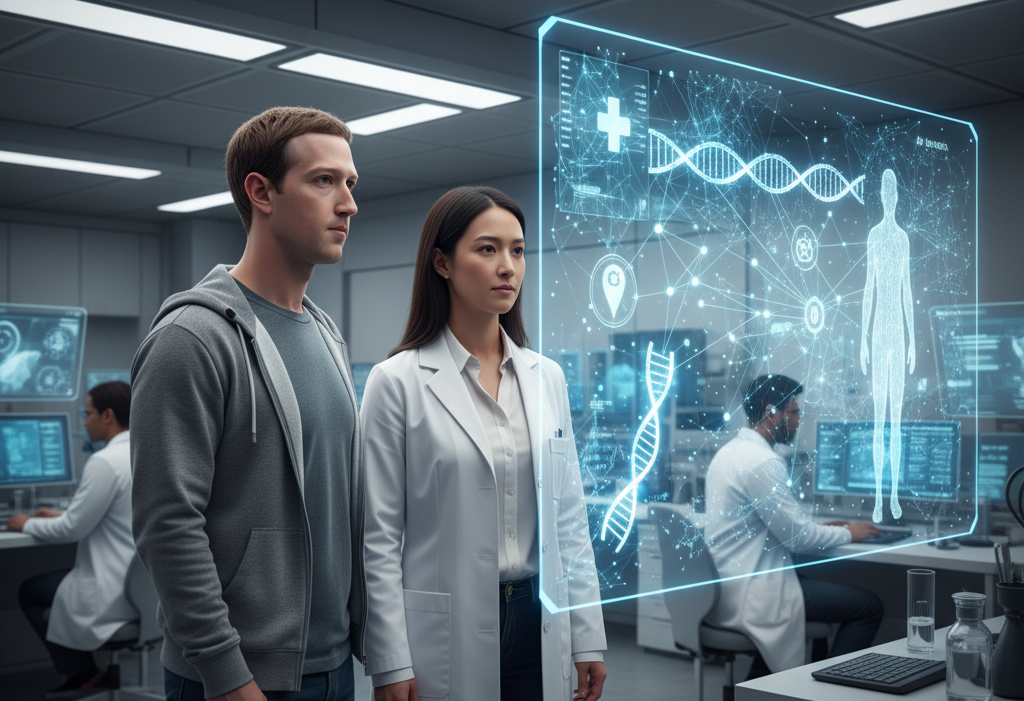
Tech billionaire Mark Zuckerberg and philanthropist Dr. Priscilla Chan has announced a bold new phase in their global philanthropy placing artificial intelligence (AI) at the center of their vision to cure, prevent, or manage all diseases within the lifetime of the next generation. The couple’s decision marks a monumental shift in their foundation’s priorities, steering away from traditional social causes toward a high-tech fusion of medical research and advanced computing.
Their initiative, under the Chan Zuckerberg Biohub, will now focus on building powerful AI-driven tools capable of decoding complex biological systems. The goal: to accelerate discoveries in genetics, immunology, and disease prevention. By integrating artificial intelligence into biology, the couple aims to revolutionize how science understands the human body, potentially enabling faster diagnosis, earlier intervention, and new cures for illnesses that remain untreatable today.
This ambitious transformation signifies a deep belief that the future of healthcare lies in computational biology. AI models will be trained to simulate human cells, predict immune responses, and analyze disease patterns at a scale that no human laboratory could achieve alone. According to early reports from Biohub researchers, these virtual models could dramatically reduce the time needed to test new drugs or therapies, compressing years of trial and error into weeks.
The new direction also represents a strategic consolidation of focus. The couple’s philanthropic organization, once known for its broad involvement in education, housing, and social reform, is now concentrating most of its financial resources on science and technology-based medical innovation. While some former initiatives are being phased out or spun off, the couple insists that science remains humanity’s greatest equalizer capable of solving global problems through data and discovery rather than politics or charity alone.
Mark Zuckerberg and Priscilla Chan have long believed that AI is not just a tool, but a catalyst for global health transformation. Their foundation’s scientists are already using machine learning to map the human immune system, understand how cells age, and identify biomarkers for early-stage diseases. They envision a world where AI-powered diagnostics can detect illnesses before symptoms appear paving the way for truly preventative medicine.
However, experts also caution that this AI-first approach brings challenges of its own. Issues of data privacy, algorithmic bias, and accessibility must be carefully managed to ensure the benefits of this medical revolution reach all, not just a privileged few. As AI begins to rewrite the future of medicine, questions of ethics, equality, and human oversight remain central to the conversation.
For Zuckerberg and Chan, the mission is deeply personal. A former doctor and a lifelong technologist, they share a conviction that the intersection of science and technology holds the key to saving lives. “We are living at the dawn of a biological revolution,” they emphasized during the announcement, “and AI will be the engine that drives it.”
As the world watches their ambitious experiment unfold, one thing is certain the future of global health is being reimagined through algorithms, data, and human determination. Whether this fusion of AI and biology will truly cure all diseases remains to be seen, but the journey marks one of the most daring leaps in the history of modern philanthropy.
Hidden risks in AI-powered healthcare
As visionary as Mark Zuckerberg and Priscilla Chan’s mission sounds, the road to curing diseases through artificial intelligence isn’t without its shadows. Experts are already warning that beneath the promise of progress lies a delicate web of risks, the very “stitches” that could unravel this technological dream if ignored.
One of the most immediate threats is data vulnerability. AI systems thrive on vast pools of medical information from genetic codes to personal health histories. But the same data that can heal could also harm if mishandled. A single breach or misuse of this deeply intimate information could lead to privacy catastrophes far beyond today’s data leaks.Then comes the problem of bias in the machine’s mind. If AI learns primarily from limited or uneven datasets, it risks developing blind spots producing flawed diagnoses or unequal care across gender, race, and region. In a field where every life matters, even a small bias in an algorithm could translate into tragedy.
There’s also the silent danger of overreliance. The more powerful medical AI becomes, the more likely healthcare systems may lean on it unquestioningly. Replacing human intuition and empathy with cold precision may streamline results but could also erode the emotional intelligence that makes medicine humane. The art of healing, after all, cannot be fully taught to a machine.
And finally, there’s the ethical paradox: as AI grows more capable of predicting, manipulating, or even rewriting biological processes, humanity must decide how far it is willing to go. Who controls the algorithm that controls life? Who decides which diseases to cure first? These questions will shape not just medicine’s future, but humanity’s moral boundaries.
AI might well become the greatest medical tool ever created but without ethical stitching to hold its progress together, it risks becoming too sharp for its own good. Innovation can heal, but without conscience, it can also cut deep.
Mark Zuckerberg AI project, Priscilla Chan Biohub, Chan Zuckerberg disease cure, AI in medical research, artificial intelligence healthcare, Zuckerberg philanthropy 2025, future of medical AI, AI cure diseases, Zuckerberg Chan AI foundation, AI in biology revolution