
|
Getting your Trinity Audio player ready...
|
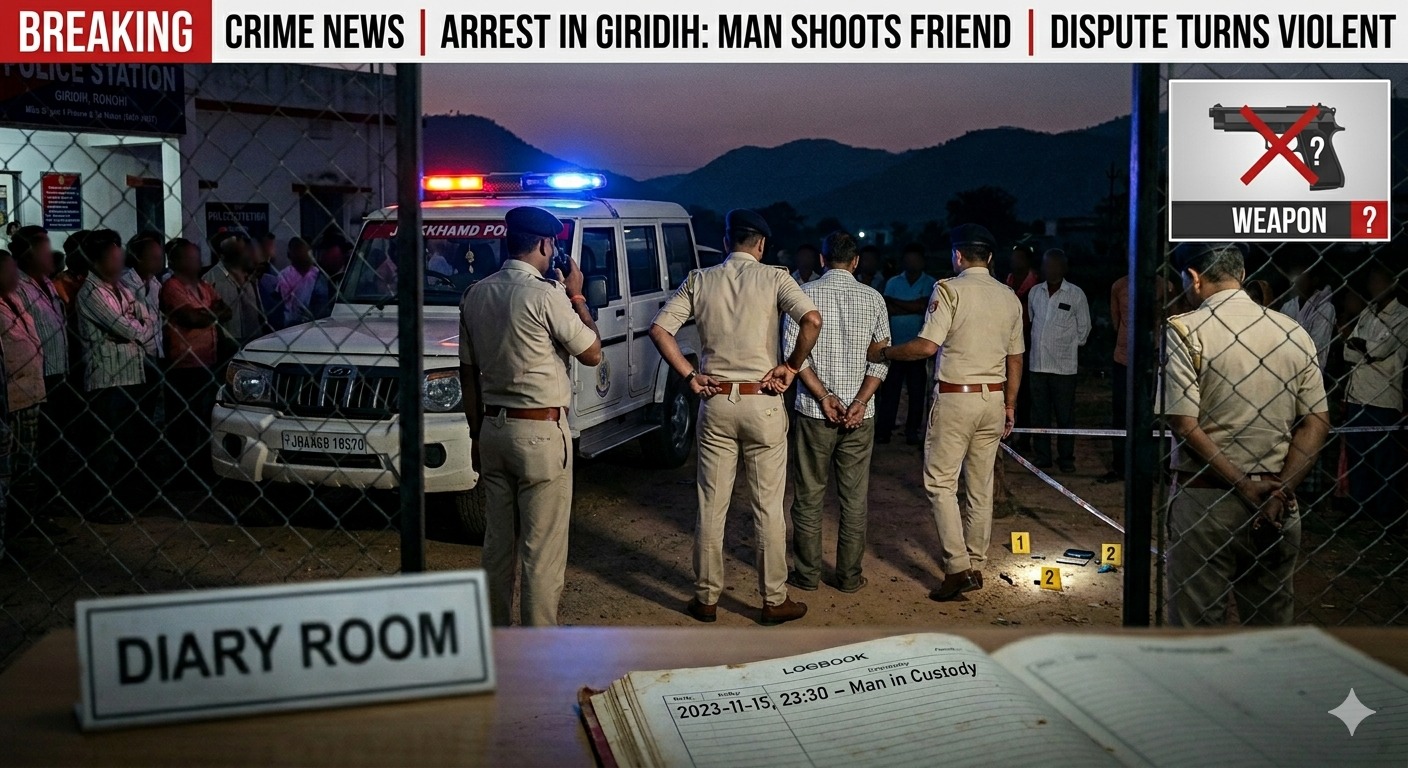
A shocking incident from Jharkhand’s Giridih district has once again highlighted how personal disputes can spiral into violent crime within moments. A man has been arrested for allegedly opening fire on his own friend following a heated argument, leaving the local community disturbed and raising serious concerns about rising impulsive violence among youth.
According to initial police findings, the incident unfolded after a disagreement between the accused and the victim escalated beyond control. What reportedly began as a verbal exchange soon turned aggressive, ultimately leading to the use of a firearm. The victim sustained injuries and was rushed for medical treatment, while the accused was later apprehended by the police.
Such cases often appear sudden on the surface, but when examined closely, they reveal a deeper pattern. Over the years, one thing has become clear in crime reporting. Most violent acts between known individuals are rarely about a single moment. They are usually the result of unresolved tension, ego clashes, or accumulated frustration that eventually reaches a breaking point.
In Giridih, local sources suggest that the two individuals were known to each other, which makes the incident even more concerning. Crimes involving acquaintances or friends tend to have a stronger psychological impact on communities because they break the perception of safety within personal circles. When trust turns into threat, the fear becomes more personal.
Police officials acted swiftly after receiving information about the incident. A case was registered, and the accused was taken into custody. The weapon used in the crime has also been seized as part of the investigation. Authorities are now working to piece together the exact sequence of events, including the motive behind the attack and whether there were prior disputes between the two.
From experience, cases like this often involve triggers that seem minor from the outside. Arguments over money, misunderstandings, personal ego, or even casual disagreements can escalate rapidly when emotions are not controlled. The presence of a weapon in such situations significantly increases the risk of irreversible consequences.
One of the critical aspects that stands out in this case is the accessibility of firearms. Even in regions where strict laws exist, illegal or unregulated access to weapons continues to pose a serious challenge. In many instances, individuals acquire firearms without fully understanding the legal and moral responsibility that comes with it.
In ground-level reporting, a common pattern emerges. People do not plan to commit violent acts. They react impulsively in moments of anger. The difference between a heated argument and a criminal case often comes down to a few seconds of uncontrolled emotion. Unfortunately, those few seconds can change multiple lives forever.
The victim’s condition is currently under medical observation. While doctors are working to stabilize the situation, the emotional toll on the family is significant. Families in such cases not only deal with physical injury but also with long-term psychological distress. The sense of betrayal is often harder to process than the incident itself.
Meanwhile, the accused is being interrogated, and further legal proceedings are underway. Police are also examining whether alcohol or other influencing factors played a role in escalating the situation. In many similar cases, substance use has been found to reduce judgment and increase aggression, turning manageable conflicts into dangerous confrontations.
The incident has sparked concern among residents, who are questioning how quickly situations can turn violent. Community members have expressed the need for stronger awareness around conflict resolution and emotional control. While law enforcement plays a crucial role in maintaining order, prevention often begins at an individual level.
From a broader perspective, this case reflects a growing issue in urban and semi-urban India. There is an increasing tendency to react instantly rather than respond thoughtfully. Social pressure, stress, financial challenges, and personal insecurities often build up beneath the surface. Without proper outlets or communication, these pressures can explode in unexpected ways.
Another factor that cannot be ignored is the normalization of aggression in everyday life. Exposure to violent content, peer influence, and lack of emotional education contribute to a mindset where confrontation is seen as a solution rather than a problem. This shift in behavior is subtle but significant.
Law enforcement agencies are expected to take strict action in this case, sending a clear message that such acts will not be tolerated. At the same time, experts emphasize the need for community-level interventions. Awareness programs, counseling initiatives, and conflict management education can play a crucial role in reducing such incidents.
It is also important to address the role of communication. Many conflicts escalate simply because individuals fail to express themselves clearly or listen to the other side. Misunderstandings, when combined with ego, can create a dangerous mix. In several past cases, timely intervention by a third person has prevented situations from turning violent.
For young individuals especially, learning how to manage anger is becoming increasingly important. In real life, strength is not shown by reacting aggressively. It is shown by maintaining control even in difficult situations. Unfortunately, this understanding is often missing, leading to decisions that cannot be reversed.
As the investigation in Giridih continues, authorities are expected to gather more details about the background of both individuals and the circumstances leading up to the incident. The legal process will determine the consequences for the accused, but the larger lesson extends beyond the courtroom.
This case is a reminder that violence is rarely the result of a single moment. It is the outcome of choices, emotions, and actions that build up over time. Addressing it requires not just legal enforcement but also social awareness and personal responsibility.
In conclusion, the Giridih shooting incident is not just another crime report. It is a reflection of how fragile human relationships can become when emotions override judgment. Preventing such incidents in the future will require a combination of stricter control, better awareness, and a shift in how individuals handle conflict in their daily lives.