
|
Getting your Trinity Audio player ready...
|
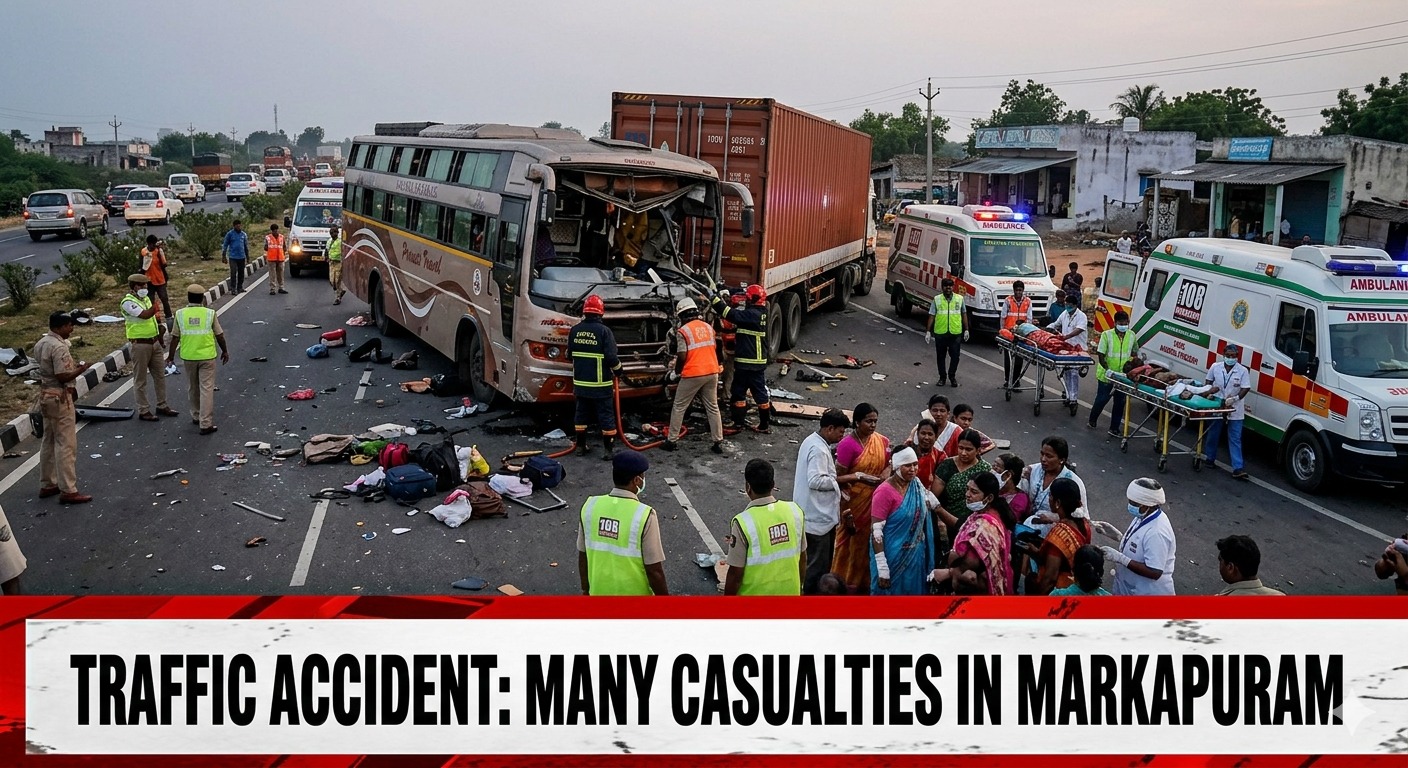
A devastating road accident in Andhra Pradesh’s Markapuram region has shaken the state, after a passenger bus collided with a truck, resulting in multiple fatalities and several injuries. The incident has once again exposed the fragile reality of road safety in India, where a single moment on the highway can turn routine travel into tragedy.
The accident occurred on a busy stretch frequently used by long-distance and local transport vehicles. According to early reports, the collision was severe, with the front portion of the bus sustaining heavy damage. Passengers onboard were caught in the impact, leaving many trapped inside before rescue teams arrived at the scene.
Local authorities and emergency services responded quickly. Police teams, along with ambulance services, rushed to the site and began rescue operations. Injured passengers were transported to nearby hospitals, while efforts were made to clear the wreckage and restore traffic flow. Eyewitnesses described the scene as chaotic, with cries for help and bystanders attempting to assist before official help arrived.
From years of covering accident scenes, one thing becomes painfully consistent. The first few minutes after a crash are the most critical, yet often the most disorganized. In Markapuram, like in many such cases, local residents played a crucial role in pulling victims out of the damaged vehicle before emergency teams could fully take control.
Initial investigations suggest that the collision may have been caused by a combination of factors. While the exact cause is still under examination, possibilities include overspeeding, driver fatigue, or misjudgment during overtaking. These are not uncommon on highways where long hours, tight schedules, and pressure to reach destinations quickly often influence driving behavior.
The condition of the vehicles involved is also being assessed. In many accidents across the country, poor maintenance, worn-out brakes, or lack of regular inspections contribute significantly to the severity of crashes. Authorities are expected to examine whether mechanical failure played any role in this incident.
The victims of the accident included passengers from different backgrounds, many of whom were traveling for routine reasons such as work, family visits, or personal commitments. This is what makes such incidents deeply unsettling. These are not isolated risks taken by individuals. They are everyday journeys that millions of Indians undertake, often without a second thought.
Medical teams at nearby hospitals are currently treating the injured, with some reported to be in critical condition. Doctors are working under pressure to stabilize patients, many of whom suffered multiple injuries due to the force of the collision. In situations like these, the availability of immediate trauma care often determines survival outcomes.
Authorities have also begun the process of identifying victims and informing families. This is one of the most emotionally challenging aspects of such incidents. Families receive sudden calls that change their lives within seconds. Having witnessed similar situations over the years, it becomes clear that the impact of such accidents extends far beyond the physical injuries.
The state administration has assured that all necessary support is being provided to the victims and their families. Compensation announcements are expected, along with assistance for medical treatment. While financial aid provides some relief, it cannot replace the loss experienced by families who have lost their loved ones.
Traffic on the affected route was temporarily disrupted as rescue and clearance operations continued. Authorities worked to remove the damaged vehicles and ensure that normal movement could resume. Such disruptions highlight how a single accident can impact not just those directly involved but also thousands of commuters relying on the same route.
From a broader perspective, this incident raises important questions about road safety enforcement. Despite strict laws and awareness campaigns, implementation remains inconsistent. Speed limits, lane discipline, and vehicle checks are often overlooked until a tragedy forces attention back onto these issues.
Driver behavior remains a critical factor. Long working hours, lack of adequate rest, and pressure from transport operators contribute to reduced alertness on the road. Fatigue is one of the most underestimated risks in highway driving. A few seconds of delayed reaction can lead to irreversible consequences.
Another aspect that often goes unnoticed is passenger awareness. Many passengers do not question unsafe driving practices or vehicle conditions. In reality, collective awareness can play a role in preventing accidents. Speaking up about reckless driving or choosing safer travel options can make a difference, even if it seems small.
Infrastructure also plays a role. Road design, visibility, lighting, and signage can influence how safely vehicles move. In several accident-prone areas, lack of proper markings or poorly maintained roads increases the likelihood of collisions. Identifying and improving such black spots should remain a priority.
Technology has the potential to reduce such incidents, but adoption remains limited. Features such as speed monitoring, driver alert systems, and real-time tracking can enhance safety, especially in commercial transport. However, these measures are not yet uniformly implemented across all regions.
The Markapuram accident is a reminder that road safety is not a single-point responsibility. It involves drivers, passengers, authorities, and infrastructure working together. When even one element fails, the consequences can be severe.
For those who travel frequently, this incident reinforces the importance of staying alert and making informed choices. Simple precautions such as choosing reliable transport services, avoiding late-night fatigue travel, and being aware of surroundings can contribute to safety.
As investigations continue, authorities are expected to release detailed findings on the cause of the accident. These insights will be crucial in preventing similar incidents in the future. Accountability, both at an individual and systemic level, will determine whether lessons are learned or repeated.
In conclusion, the bus-truck collision in Markapuram is not just another accident report. It is a reflection of ongoing challenges in road safety that require urgent and sustained attention. Behind every statistic are real lives, families, and stories that deserve more than temporary concern.