
|
Getting your Trinity Audio player ready...
|
Sources: Kofluence Influencer Marketing Report 2025 (Business Standard, July 8, 2025); FLAME University Mental Health Analysis 2025 (flame.edu.in); Upgrad Instagram Salary Report February 2026 (upgrad.com); Social Snowball Influencer Marketing Statistics 2025 (socialsnowball.io). Cited inline.
March 2026
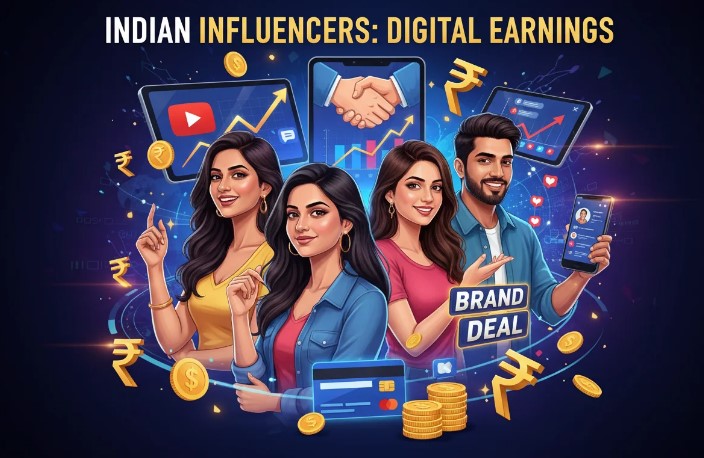
India’s influencer marketing industry crossed Rs 3,000 to Rs 3,500 crore in 2025, according to the Kofluence Influencer Marketing Report, built on data from over 1,000 creators, brands, and industry experts. Globally, the influencer economy is projected to reach 32.55 billion US dollars by the end of 2025, up from 24 billion in 2024 and just 1.4 billion a decade ago. Those numbers have made the creator economy one of the fastest-growing sectors in digital advertising and, in India specifically, one of the most aspirational career paths for anyone under 30 with a phone and an opinion.
What those numbers do not show is what the economy looks like from inside it, which tier you are in, what it pays at each level, what it costs to maintain the appearance of being in it, and what it does to the people who are.
The earnings structure of India’s influencer economy in 2025 is not a ladder. It is a cliff. At the bottom, nano creators with fewer than 10,000 followers earn between Rs 500 and Rs 5,000 per Instagram Reel, according to the Kofluence 2025 report. Micro-influencers in the 10,000 to 100,000 follower range earn more per post and are increasingly the preferred choice for regional and hyper-local campaigns, with brands favouring their higher engagement rates over the raw reach of larger accounts. At the top, mega influencers and celebrities command Rs 2 lakh and above per Reel. Globally, Cristiano Ronaldo earns 2.3 million US dollars per sponsored post. Kylie Jenner earns 1.8 million. These figures are cited not as Indian benchmarks but as the aspirational ceiling the creator economy places in front of every person who opens a camera.
The gap between that ceiling and the floor where most creators actually work is the part of the influencer economy that rarely trends. India had an estimated 1.8 to 2.3 million Instagram creators alone in 2025, according to Kofluence data. Of those, the overwhelming majority earn at nano or micro rates. Instagram contributed 5.57 million sponsored posts to the global count in 2024, making India the third-largest market for influencer content by volume. Most of those posts were produced by creators whose monthly income from the platform did not equal a starting salary in any urban profession.
The cost structure makes this gap more acute. Content creation in 2025 is not a phone and a face. It requires equipment, editing software, lighting, sometimes a studio, sometimes a team. It requires time that does not clock out. The Kofluence report notes that short-form video has emerged as the dominant monetisation vehicle, and short-form video, despite appearing effortless, is among the most labour-intensive content formats to produce at competitive quality. Algorithms reward consistency, which means the creator who posts once a week and takes Sundays off is structurally penalised relative to the creator who does not. Brand deals, which represent the primary income stream for most mid-tier creators, are negotiated individually, paid irregularly, and can be withdrawn at any point. There is no minimum wage. There is no sick leave. There is no severance.
The mental health dimension of this economy has moved from anecdote to documented trend in 2025. A FLAME University analysis published this year, drawing on data from business publications and mental health research, noted that managing a social media presence with constant posting, audience interaction, and brand deliverable management creates a psychological load that triggers burnout, anxiety, and depression at rates disproportionate to most other professions. The analysis cited the death of 24-year-old influencer and entrepreneur Misha Agarwal, who passed away two days before her 25th birthday in 2025, as an instance that put the sector’s mental health crisis into sharp, public focus.
The structural reason for this is documented as clearly as the earnings data. The line between the creator’s professional identity and personal identity thins until it effectively disappears. The platform does not distinguish between the person and the content they produce. The algorithm does not pause when something goes wrong offline. The follower count, which functions simultaneously as a metric of professional worth and a social validation mechanism, fluctuates publicly and in real time. The Upgrad influencer salary report published in February 2026 described maintaining an online image as one of the toughest aspects of the profession, noting that the pressure to appear perfect feeds stress and burnout in ways that are difficult to separate from the job itself.
India’s creator economy is growing at a CAGR of 22 percent, according to Kofluence’s 2025 data. The government announced a 1 billion US dollar creator economy fund in March 2025 to support regional content and unlock local talent. Tier-2 and Tier-3 city creators are entering the economy in significant numbers, producing content in Tamil, Telugu, Bengali, and Marathi for audiences that metro creators have consistently underserved. The democratisation of the economy is real, and it is among the most genuinely inclusive developments in Indian digital media in a decade.
What has not been democratised is the understanding of what the economy actually costs the people inside it. The Rs 3,500 crore industry figure is accurate. The Rs 500 per Reel figure for nano creators is also accurate. The 22 percent growth rate is accurate. So is the burnout rate. So is the absence of any formal safety net for the 3.5 to 4.5 million creators whose labour collectively produces the numbers that make the industry look so attractive from the outside.
The influencer economy in 2025 is not a scam and it is not a dream. It is an industry with a genuine earnings ceiling, a very real earnings floor, a structural pressure system that has no off switch, and almost no institutional acknowledgment that the people powering it need the same protections that every other industry provides its workers as a matter of course.
SOURCE LOG
Rs 3,000-3,500 crore India influencer market 2025, 3.5-4.5 million creators, 22% CAGR: Kofluence, “Decoding Influence: The 2025 Influencer Marketing Report,” Business Standard/The Print ANI, July 8, 2025 (business-standard.com)
Nano creators Rs 500-Rs 5,000 per Reel, mega influencers Rs 2 lakh and above: Kofluence 2025 Report; Upgrad, “Instagram Influencer Salary in India 2026,” upgrad.com, February 3, 2026
Global influencer market USD 32.55 billion by end of 2025, USD 24 billion in 2024: Social Snowball, “40+ Influencer Marketing Statistics To Know in 2025,” socialsnowball.io
Ronaldo USD 2.3 million per post, Kylie Jenner USD 1.8 million: Social Snowball, socialsnowball.io
India 1.99 million Instagram influencers, 5.57 million sponsored posts 2024: Social Snowball, socialsnowball.io; Kofluence 2025
Burnout, anxiety, depression documentation in creator economy: FLAME University, “Social Media Influencers and Mental Health: The Hidden Toll,” flame.edu.in, 2025
Misha Agarwal, 24-year-old influencer, died 2 days before 25th birthday: FLAME University 2025, citing Business Standard 2025
Government USD 1 billion creator economy fund, March 2025: Kofluence 2025 Report (kofluence.com)
Tier-2 and Tier-3 regional content growth: Kofluence 2025 Report; Sreeram Reddy Vanga CEO quote, Business Standard July 2025
Rs 2,344 crore in 2023 projected to Rs 3,375 crore in 2026: FLAME University 2025, citing Firstpost 2024