
|
Getting your Trinity Audio player ready...
|
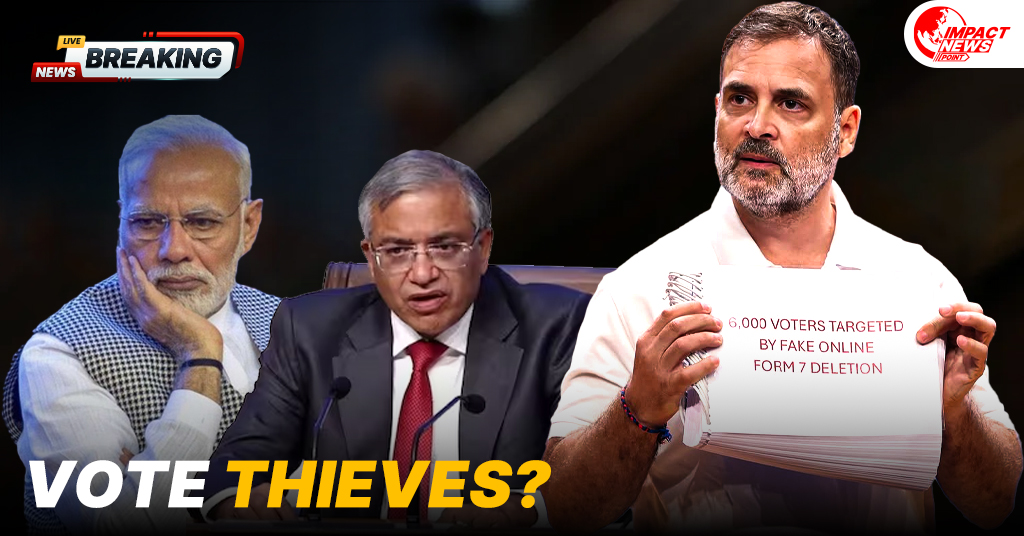
A new chapter has unfolded in India’s political drama as Congress leader Rahul Gandhi takes on the Election Commission (EC), demanding answers over alleged “vote theft” incidents. At the heart of his claims is the accusation that thousands of opposition votes were erased in Karnataka’s Aland constituency during the 2023 elections, many belonging to Dalits, OBCs, Adivasis, minorities, and other opposition supporters.
Rahul Gandhi’s message was urgent and personal. He shared the story of a booth-level officer in Karnataka who discovered her uncle’s name missing from the voting list. Investigating further, she discovered a neighbor’s phone number had been misused to apply for the deletion—yet neither the uncle nor the neighbor had been involved. Gandhi said this wasn’t an isolated case, but part of a larger pattern where outside numbers and software were used to delete votes in bulk, without the actual voters’ knowledge.
According to him, this wasn’t just a technical issue but a real threat to the health of India’s democracy. He insisted he was showing “proof in black and white” as clear as it gets.
Political Firestorm: Parties Exchange Heated Words
The ruling party, BJP, fired back immediately. Leaders like Amit Shah called Gandhi’s claims a “pack of lies,” dismissing his press conference as purely dramatic. “Have any of you lost your vote?” Shah asked party workers, suggesting that the Congress leader was only searching for excuses. BJP’s Anurag Thakur went a step further, pointing out that Congress actually won the Aland seat. “So is Congress accusing themselves of stealing the votes?” he mocked. Amit Malviya also chimed in, highlighting that Congress candidate B.R. Patil emerged victorious, which, he argued, made the accusations even more questionable.
Election Commission Tries to End the Doubts
The Election Commission responded quickly, calling Rahul Gandhi’s charges “incorrect and baseless.” According to the EC, every single deletion must be heard before being finalized. Officials admitted there were attempts at mass deletion of voters’ 6,018 applications in Aland but stressed that only a tiny fraction (24 deletions) were justified and the rest were rejected on scrutiny. An FIR was filed, and the EC emphasized that all requested information had been given to the local police.
They also pointed to existing rules ensuring that no votes could simply “disappear” without due process.
Continuing the Debate
Despite official denials, Rahul Gandhi doubled down, urging the commission to release more technical details like device logs and IP addresses insisting that full transparency hadn’t been granted. The controversy has put the spotlight back on India’s election processes, with both sides digging in and calling their supporters to defend democracy as they see it. The entire episode highlights the increasing use of technology and its potential pitfalls in India’s election system, as well as the sharp, personal tone that often defines modern Indian politics. Trump’s Trade War Tariffs on India Likely to End Soon, Says Top Economic Advisor