

|
Getting your Trinity Audio player ready...
|
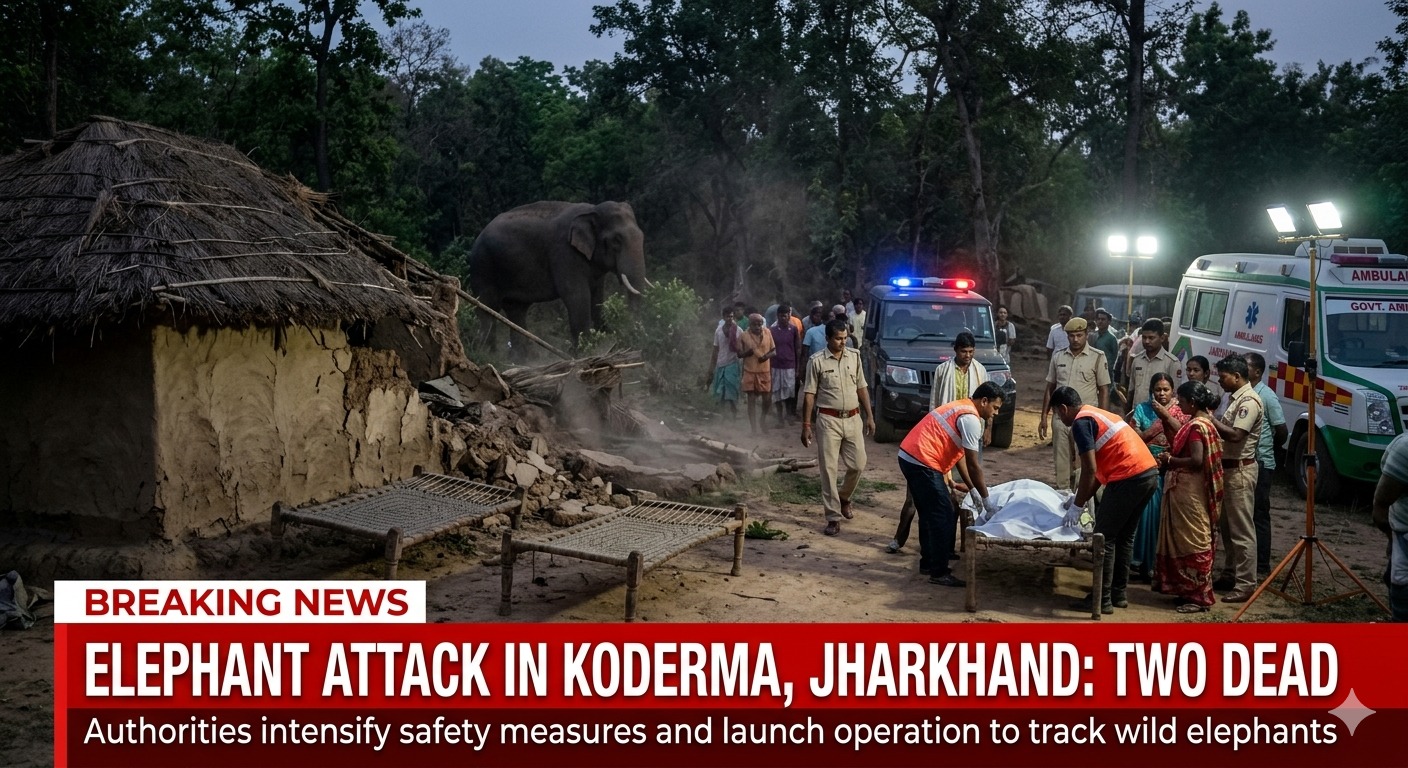
A tragic incident in Jharkhand’s Koderma district has once again brought the growing issue of human-elephant conflict into sharp focus. Two people lost their lives after being attacked by a wild elephant, triggering fear across nearby villages and prompting authorities to step in with urgent safety measures.
The incident occurred in a forest-adjacent area where human settlements and elephant corridors often overlap. According to initial reports, the victims were caught off guard, a pattern that has become increasingly common in such encounters. What makes these incidents more alarming is not just their frequency, but the unpredictability that surrounds them.
For those who have observed wildlife conflict zones closely, this is not an isolated tragedy. It is part of a larger, slowly escalating pattern where shrinking forests and expanding human settlements are forcing both humans and animals into dangerous proximity.
Local residents described the situation as tense and unsettling. Fear spread quickly after the attack, with many villagers choosing to stay indoors after sunset. In areas like Koderma, daily life often depends on early morning and late evening outdoor activities, including farming and collecting forest resources. Incidents like this disrupt not just safety, but livelihoods.
Authorities responded swiftly after the attack. Forest department teams were deployed to track the elephant’s movement and prevent further incidents. Surveillance in vulnerable zones has been increased, and local administration has begun coordinating with village leaders to issue safety advisories. Measures such as patrolling, awareness drives, and early warning systems are being reinforced.
However, from years of covering such incidents, one thing becomes clear. Immediate response is only one part of the solution. The deeper issue lies in long-term planning, which often lags behind the pace at which these conflicts are rising.
Elephants are highly intelligent and migratory animals. They follow traditional routes known as corridors, many of which now pass through areas that have been converted into farmland or residential zones. When these natural pathways are blocked or disturbed, elephants often stray into villages, leading to encounters that can turn fatal.
In many cases, these animals are not aggressive by nature. They react to perceived threats, sudden movements, or human presence in what they consider their territory. Unfortunately, lack of awareness among local populations about elephant behavior increases the risk. Simple mistakes such as approaching too closely, making loud noises, or attempting to drive the animal away without proper support can escalate the situation.
In Koderma, officials have begun implementing precautionary measures to reduce further risk. These include identifying high-risk zones, restricting movement in certain forest fringes during vulnerable hours, and using alert systems to inform residents about elephant sightings. In some areas, teams are also exploring the use of traditional deterrents such as firecrackers or coordinated noise methods to safely guide elephants away from human settlements.
Compensation processes for the victims’ families are also being initiated. While financial aid provides some relief, it does little to address the emotional and psychological impact such incidents leave behind. Families in these regions often live with a constant sense of uncertainty, knowing that such encounters can happen without warning.
From a ground-level perspective, one of the most common issues is delayed information flow. By the time villagers become aware of elephant movement, it is often too late. This highlights the importance of real-time communication systems, something that many regions are still struggling to implement effectively.
Another challenge is balancing conservation with human safety. India is home to a significant population of Asian elephants, and protecting them is as important as safeguarding human lives. However, without proper land management and planning, both objectives can come into conflict.
In recent years, there have been efforts to map elephant corridors more accurately and prevent encroachments. Some states have also introduced community-based monitoring systems, where local residents actively participate in tracking animal movement and spreading alerts. These models have shown promise, but their implementation remains inconsistent.
What is often overlooked in urban discussions is the daily reality of people living in such zones. For them, this is not just a news headline. It is a lived experience. Stepping out at dawn or dusk carries a level of risk that most city dwellers never have to consider. Children, farmers, and elderly residents are particularly vulnerable.
There is also a behavioral aspect that needs attention. In many cases, curiosity or overconfidence leads individuals to ignore warnings. Some attempt to capture videos or get closer to the animal, not realizing the danger involved. Awareness campaigns need to address these human tendencies, not just provide instructions.
Looking ahead, experts believe that technology could play a bigger role in managing such conflicts. Use of GPS tracking, drone surveillance, and mobile alert systems can significantly improve response time and preparedness. However, technology alone cannot solve the problem. It needs to be supported by strong local coordination and consistent policy implementation.
The Koderma incident serves as a reminder that human-wildlife conflict is not a distant issue. It is immediate, real, and growing. As development continues to expand into forest areas, such encounters may become more frequent unless proactive steps are taken.
Authorities have assured that all necessary measures are being implemented to prevent further loss of life. Patrols have been intensified, and residents are being advised to remain cautious, especially during early morning and late evening hours. Schools and local institutions are also being informed to take necessary precautions.
For now, the focus remains on ensuring safety and preventing further tragedy. But the larger question remains unresolved. How can India balance development, conservation, and human safety in a way that prevents such incidents from repeating?
In conclusion, the loss of two lives in Koderma is not just a statistic. It is a stark reminder of a growing challenge that requires urgent and sustained attention. Addressing it will require more than immediate action. It will demand long-term vision, community involvement, and a deeper understanding of the delicate balance between humans and wildlife.